

.svg)
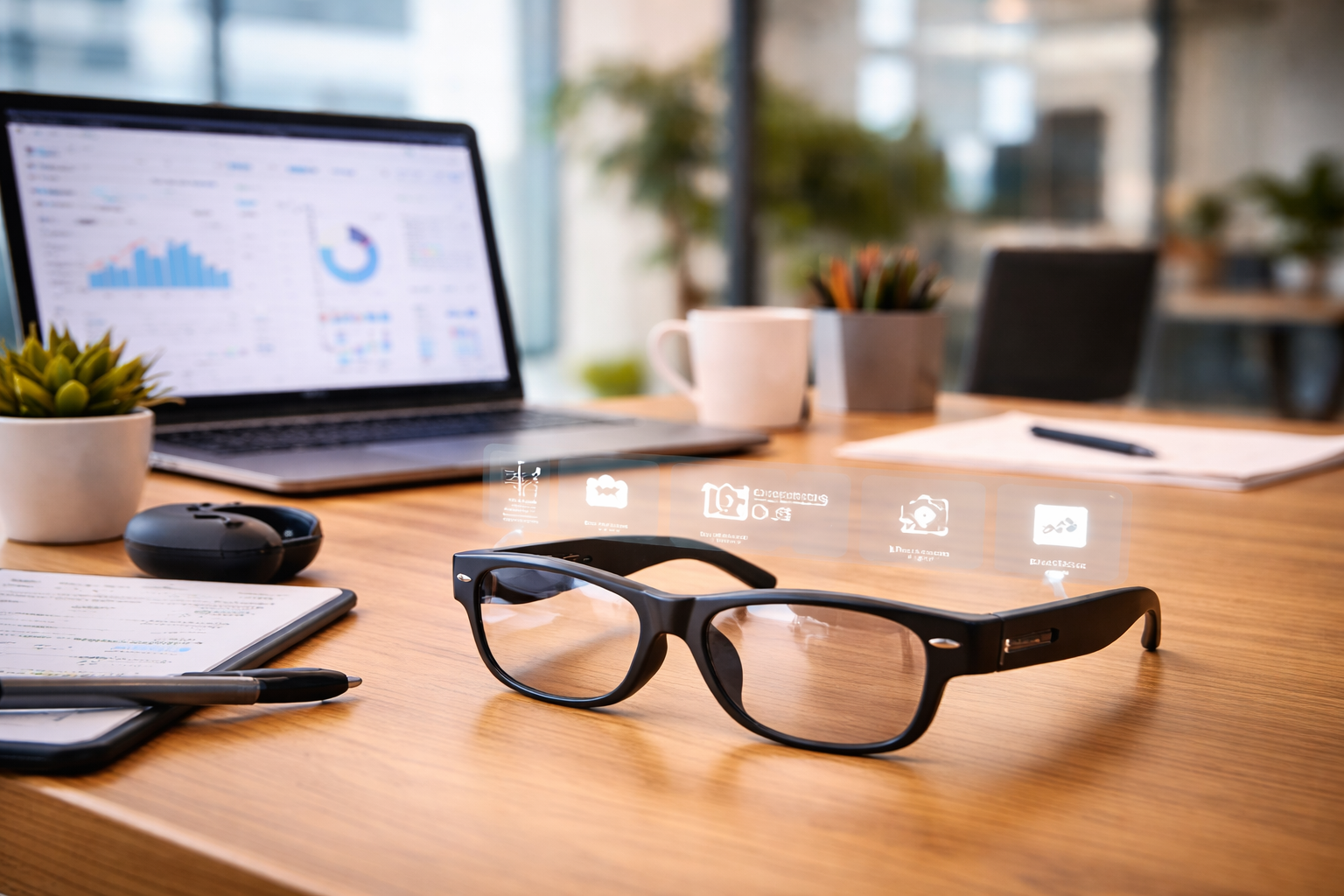
For decades, productivity tools followed a simple rule: more screens, more apps, more tabs. Laptops replaced paper, smartphones replaced laptops, and work slowly became something we constantly looked down at.
In 2026, that model is breaking.Smart glasses and AI smart glasses are emerging as productivity tools designed to remove friction, not add it. In India especially, where work is increasingly mobile, distributed, and hands-on, AI glasses are finding real-world relevance across offices, factories, hospitals, and field teams.
Instead of demanding attention, smart glasses deliver assistance at the exact moment it’s needed — hands-free, eyes-up, and context-aware.
Smart glasses for productivity are AI-powered wearable devices that assist with work tasks by providing hands-free information, context-aware prompts, visual guidance, and real-time assistance without replacing phones or laptops.
They function as ambient computing tools, supporting daily work instead of interrupting it.
👉 For a complete category overview, see:
[Smart Glasses in 2026: The Complete Guide to AI Smart Glasses in India]
India’s work environment is uniquely suited to smart glasses adoption:
- A mobile-first workforce
- Rapid digitization across industries
- High adoption of wearables and voice assistants
- Growing need for hands-free, on-the-go productivity
From logistics hubs to startup offices, AI smart glasses in India solve a common problem: too many micro-interruptions slowing work down.
Instead of switching between apps, workers receive just-in-time assistance through smart glasses with camera and voice-controlled AI.
Traditional productivity software is reactive - you open an app, search, then act.
AI smart glasses operate proactively.
Using cameras, microphones, and sensors, smart glasses with AI understand:
- What you’re looking at
- Where you’re working
- What task is underway
- What information is likely needed next
This is context-aware computing, and it’s what makes smart glasses useful at work instead of distracting.
Examples:
- Visual checklists during equipment servicing
- Location-based task reminders
- AI prompts triggered by real-world objects
This shift from apps to assistance is central to next-generation productivity.
In 2026, the camera is not a content feature, it’s a productivity sensor.
Smart glasses with camera enable:
- Hands-free documentation
- Visual reference capture
- AI-based object recognition
- First-person troubleshooting and audits
For Indian industries like manufacturing, construction, healthcare, and logistics, this removes the need to pause work to use phones or tablets.Visual input gives AI glasses the context needed to provide accurate, task-specific assistance.
Not all productivity glasses need displays — but smart glasses with display unlock specific workflows.
They are most effective for:
- Navigation overlays in large facilities
- Step-by-step task instructions
- Status alerts and reminders
- Lightweight heads-up dashboards
Modern display-based smart glasses are designed to stay peripheral, not immersive. They support work without pulling attention away from it.
👉 For a broader breakdown of camera-first vs display-based devices, see:
[Smart Glasses in 2026: AI Smart Glasses, Displays, Cameras, and Buying in India]
In professional environments, AI smart glasses act as silent assistants.
They can:
- Transcribe meetings
- Generate summaries
- Extract action items
- Surface contextual reminders
This allows professionals to stay engaged while AI handles background tasks, a key benefit for fast-paced Indian work environments.
The strongest adoption of smart glasses for productivity in India is happening outside traditional offices.
Industries seeing value:
- Manufacturing and industrial operations
- Warehousing and logistics
- Healthcare and clinical environments
- Construction and infrastructure
Here, AI smart glasses improve:
- Safety through hands-free operation
- Accuracy with visual guidance
- Training speed and consistency
- Remote expert collaboration
These are measurable productivity gains and not speculative ones.
Workplace adoption depends on trust.
In 2026, productivity-focused AI smart glasses in India prioritize:
- On-device AI processing
- Minimal cloud dependency
- Visible camera indicators
- Compliance with Indian data protection norms
For enterprises, this ensures smart glasses remain assistive tools and not surveillance devices.
Smart glasses are no longer experimental productivity tools.
In 2026, AI smart glasses in India are quietly changing how work gets done by removing friction from everyday tasks.The best smart glasses don’t demand attention.
They disappear and make work easier in the process.
[The Economic Times] – Google and Samsung Pivot to AI: Gemini-Powered Smart Glasses to Launch in 2026
[IMARC Group] – India AR and VR Smart Glasses Market Outlook: Growth in Enterprise and Industrial Sectors (2025-2033)
[UC Today] – The 2026 Business Case for Smart Glasses: Operational Efficiency and Remote Collaboration
[Syrma SGS Insights] – The Next Big Leap: How Smart Glasses are Bridging Digital Intelligence and the Real World
[Polaris Market Research] – AI Smart Glasses Market: 5 Trends Reshaping Workplace Productivity by 2026
[Business Wire India / Omdia] – Global AI Glasses Market to Exceed 10 Million Units in 2026 as Ambient AI Goes Mainstream
[Medical Futurist] – Smart Glasses in Healthcare: From Surgical Overlays to AI Clinical Assistants
[Dutch IT Channel / Gartner] – Smartglasses Will Bring Innovation to Workplace Efficiency: Field Service and Heavy Industry Impact
[Workplace Privacy Report] – The Hidden Legal Minefield: Compliance and Biometrics in AI Smart Glasses
[DigitalDefynd] – 10 Ways AI is Revolutionizing the Eyewear Industry: From Manufacturing to Maintenance (2026)

By signing up, you are agreeing to Terms of service and Privacy policy.
You can withdraw consent at any time.
.svg)
.svg)
.svg)

.png)
