

.svg)
.png)
Smart glasses are no longer a futuristic concept or a half-baked tech demo. In 2026, they sit at the intersection of AI, optics, cameras, and wearables, quietly becoming one of the most important consumer hardware categories after smartphones.
From camera-first glasses like Ray-Ban Meta to upcoming display-based AI smart glasses, the question is no longer if smart glasses will matter — it’s which ones are actually worth buying, especially in India.
This guide breaks down everything that matters: technology, features, pricing, use cases, and what to realistically expect from smart glasses in 2026.
At their core, smart glasses are wearable computers built into eyewear. But in 2026, that definition has evolved.
Modern AI smart glasses combine:
- Cameras for first-person capture
- Microphones for voice input
- Speakers or bone-conduction audio
- Sensors for context and movement
- AI models for interpretation and assistance
Some smart glasses add displays. Many don’t. And that distinction matters.
These prioritize capture and AI assistance, not visuals.
What they do well:
- Hands-free photos and video
- Voice-based AI queries
- Calls, music, notifications
- Lightweight, all-day wear
Limitations:
- No visual overlays
- Heavily dependent on your phone
This category dominates today because it’s practical, affordable, and socially acceptable.
These are closer to what people imagine when they hear “smart glasses.”
What they unlock:
- Navigation overlays
- Real-time translation
- Contextual prompts and instructions
- HUD-style information
Trade-offs:
- Higher cost
- Heavier hardware
- Battery and heat constraints
In 2026, display-based smart glasses are improving fast - but they’re still early.
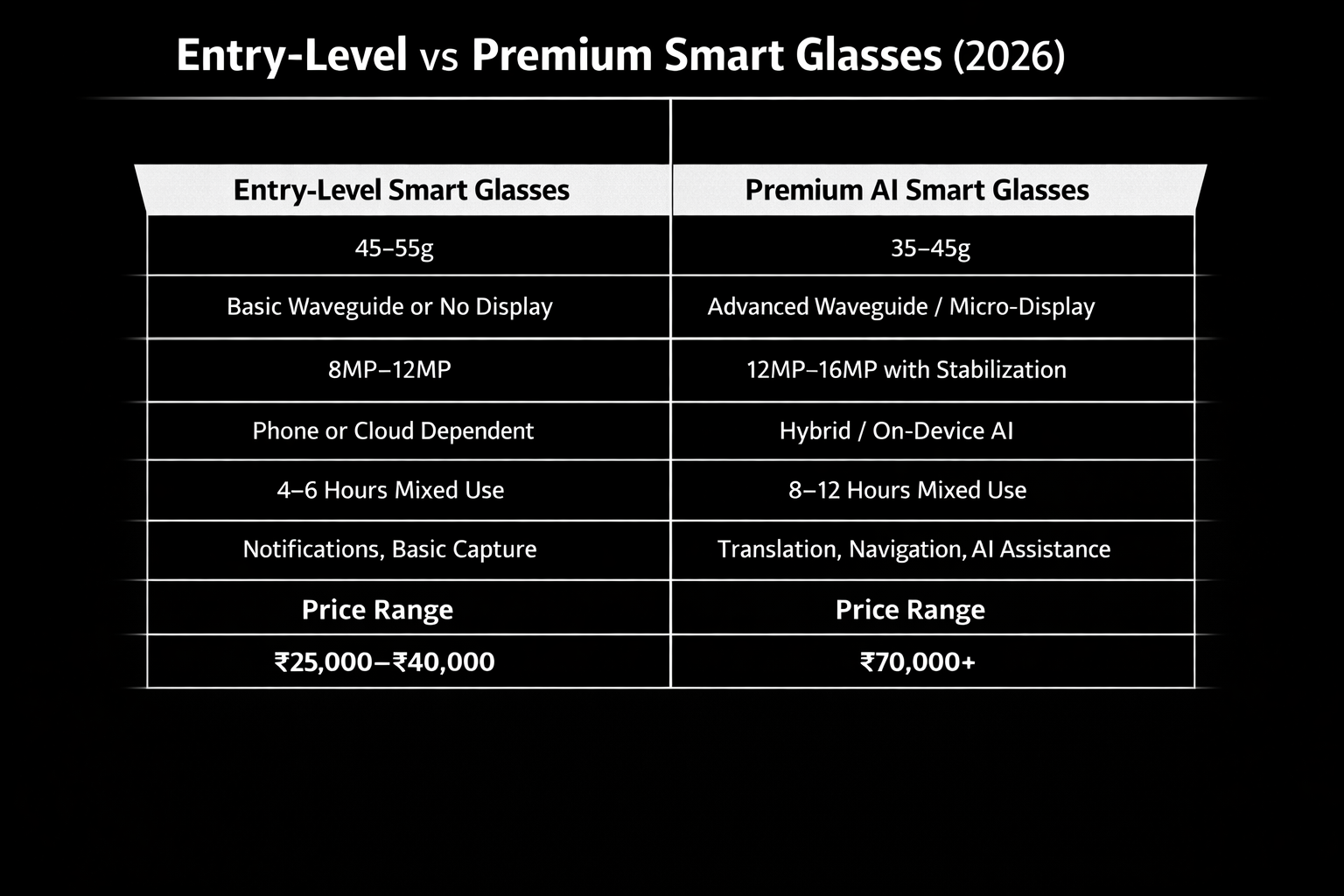
Displays are what separate useful smart glasses from gimmicks.
The main technologies used today:
- Waveguides – transparent, lightweight, limited brightness
- Micro-OLED / Micro-LED – sharper visuals, higher power draw
The challenge isn’t resolution - it’s brightness, field of view, heat, and battery life, all inside something that still needs to look like normal glasses.
This is why many companies delay display launches or ship limited features first.
In 2026, the camera is arguably the most important component of smart glasses.
Why?
- AI relies on vision
- First-person perspective unlocks context
- Video capture drives social use cases
Key specs that actually matter:
- Stabilization (not megapixels)
- Low-light performance
- AI-assisted capture
Smart glasses with bad cameras fail fast, regardless of how good the AI sounds on paper.
Ignore the buzzwords. In practice, AI smart glasses are good at:
- Voice queries without pulling out your phone
- Summarizing what you’re looking at
- Translating signs and menus
- Contextual reminders
What they’re not good at (yet):
- Full autonomy
- Complex visual reasoning offline
- Replacing phones
The best experiences come from tight hardware–AI integration, not raw model size.
Several brands are defining what consumers expect from smart glasses in 2026:
- Xiaomi Smart Glasses – Aggressive pricing, solid hardware, value-oriented.
- Jio Smart Glasses – Ecosystem-first design, connectivity focus, mass-market potential in India.
- Ray-Ban Meta (formerly Facebook/Meta) – Premium styling, AR-ready displays, social media integration.
- Snap Spectacles 4 / 5 – Lightweight first-person capture, content creator focus, AI-assisted recording.
- Apple Glasses (anticipated) – Expected to emphasize seamless AR integration, high-quality displays, and ecosystem connectivity.
- Vuzix and Epson Moverio – Enterprise-focused smart glasses, strong in industrial, logistics, and healthcare use cases.
Even when consumers don’t purchase these exact models, they act as benchmarks for features, price expectations, and usability across the smart glasses category. These benchmarks also help Indian buyers compare AI smart glasses, displays, cameras, and pricing effectively.
Smart glasses price in India varies significantly depending on features, brand positioning, and whether the glasses include displays.
Expected price ranges:
Camera-first smart glasses: ₹25,000 – ₹40,000
Display-based AI smart glasses: ₹70,000 and above
Prices remain high because:
- Optical components are expensive
- Volumes are still low
- AI and camera stacks add cost
India is expected to see more competitive pricing as local assembly and adoption increase.
Smart glasses make sense if you:
- Capture content frequently
- Want hands-free AI assistance
- Use navigation or translation often
- Prefer subtle wearables over screens
They’re not ideal if you expect:
- Phone replacement
- Full AR experiences
- All-day battery with heavy display use
Smart glasses shine when used alongside a phone, not instead of one.
India is uniquely positioned for smart glasses adoption:
- Mobile-first population
- Strong creator economy
- Growing comfort with wearables
As AI models get smaller and optics improve, smart glasses will transition from niche gadgets to everyday computing devices.
2026 isn’t the peak — it’s the starting line.
Smart glasses in 2026 are no longer experiments. They’re real, improving fast, and carving out a clear role in consumer tech.The best AI smart glasses balance comfort, camera quality, and practical AI features and not flashy demos.
If you’re buying in India, focus on use case first, not hype. The right smart glasses should disappear on your face — and quietly make life easier.
LiveMint India – Top Smart Glasses for Tech Enthusiasts: The 2026 India Market Guide
ZDNET – CES 2026: The Best Smart Glasses and Augmented Reality Wearables Ranked
Google Blog – Android XR and Gemini: Building the Future of Smart Glasses Ecosystems
The Verge – Real-Time Linguistic Overlays: How Live AI Translation is Changing Smart Eyewear
Reuters – The Evolution of AI Video and Real-Time Language Processing in Wearables
RayNeo Research – Implementation Guide: How Smart Glasses Translation Modes Work in 2026
NCBI / PubMed Central – The Impact of Smart Glasses on Cognitive Processing and Daily Assistance
ResearchGate – Multifunctional Assistive Smart Glasses: A Study on Visual and Linguistic Aids
Wikipedia – The History and Technical Evolution of Multimodal AI Smart Glasses
QWR Insights – HUMBL: Localized AI and the Future of Indian Wearable Technology

By signing up, you are agreeing to Terms of service and Privacy policy.
You can withdraw consent at any time.
.svg)
.svg)
.svg)

.png)
