

.svg)

Intelligent wearables and XR devices don’t fail because of weak hardware.
They fail because the infrastructure behind them can’t keep up.
Smart glasses, AR overlays, and immersive XR systems demand real-time responsiveness. Milliseconds matter. A slight delay can break immersion, cause motion sickness, or make an AI-powered wearable feel unreliable. This is where 5G and edge computing stop being buzzwords and start becoming foundational technologies.
Before we dive deeper, it’s useful to understand how smart glasses are bridging human perception and machine intelligence, where edge processing and real-time context play critical roles — a trend explored in Smart Glasses AI: The Interface Between Human Perception and Machine Intelligence
In India, the rapid rollout of 5G and growing edge infrastructure are quietly enabling a new class of intelligent wearables and XR devices — lighter, faster, and far more capable than what was possible just a few years ago.
Intelligent wearables are not standalone products. They are part of a distributed system.Smart glasses, XR headsets, and AI-powered wearables continuously capture visual, spatial, and contextual data. This data needs to be processed, interpreted, and turned into real-time feedback — often in under 20 milliseconds. Traditional networks were never designed for this level of responsiveness.
This is why 5G-enabled immersive technologies like AR and VR are increasingly seen as infrastructure problems rather than hardware challenges (Ericsson).
India’s expanding 5G networks, combined with localized edge computing, form an invisible connectivity layer that allows wearables and XR devices to behave intelligently without being bulky, power-hungry, or tethered to external hardware.
XR and intelligent wearables are fundamentally latency-sensitive systems.
In AR and VR, delays between head movement and visual updates — known as motion-to-photon latency — immediately break immersion. In smart glasses, delayed AI inference makes contextual overlays feel inaccurate or unsafe. Cloud-only architectures struggle here because data must travel long distances before being processed and returned.
With trends like VR in Training, you can see how immersive systems need reliable connections to deliver timely feedback in real environments.
5G is not simply a faster version of 4G. It fundamentally changes how devices communicate.
Ultra-low latency enables near-instant feedback for spatial mapping, AR overlays, and real-time interaction. High throughput allows high-resolution visual data to stream without aggressive compression. Device density ensures XR systems remain stable even in crowded enterprise environments.
This is the same architectural shift that makes immersive applications in How XR Is Transforming Learning scalable within educational environments.
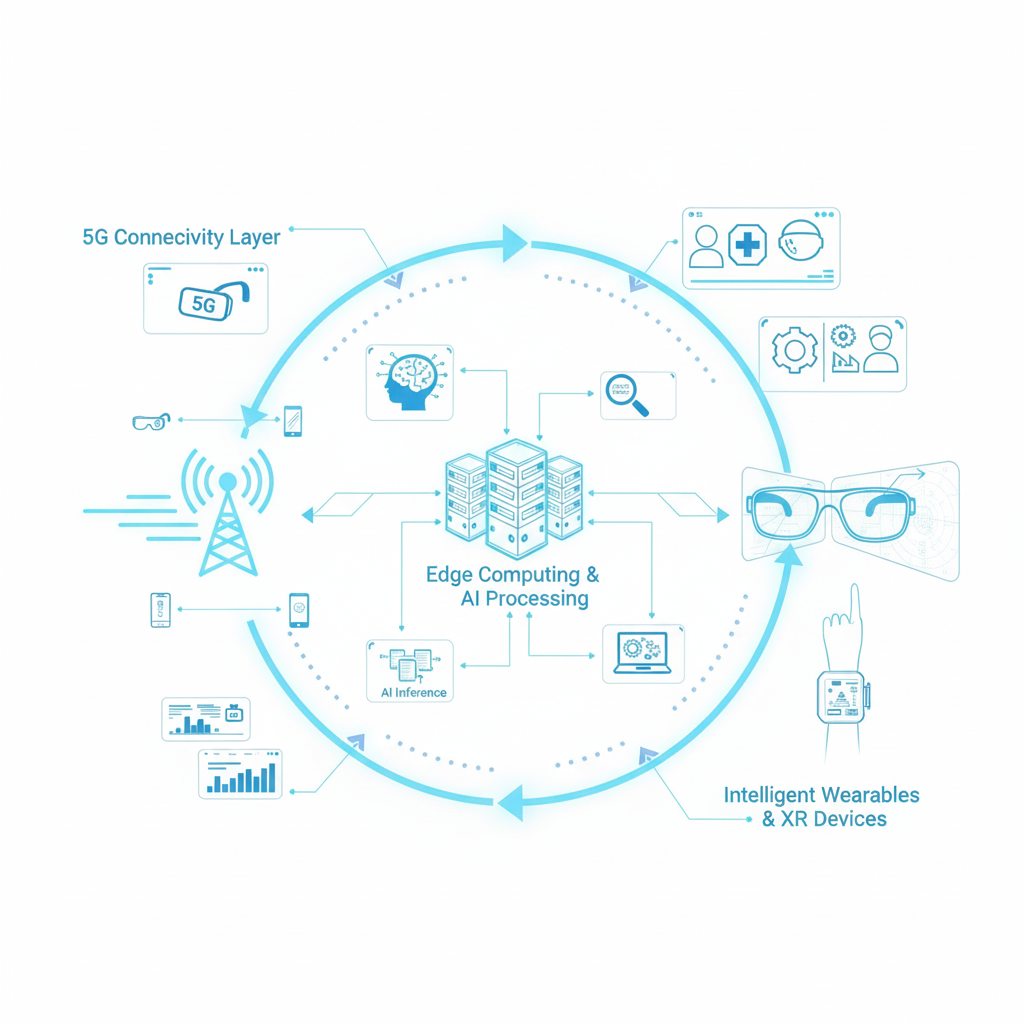
Edge computing brings intelligence closer to the user.Instead of sending data to distant cloud servers, AI inference and spatial processing happen at localized edge nodes — often within the same city, campus, or enterprise network. This dramatically reduces round-trip latency and improves system reliability.
For intelligent wearables, edge computing enables:
-Real-time AI inference without cloud delay
- Improved data privacy by limiting raw data transmission
- Lower power consumption on-device
- Predictable performance for mission-critical use cases
These principles are directly connected to how assistive wearables are empowering real users - from accessibility to productivity, as seen in Assistive AI Wearables, Empowering India’s Future.
Modern XR systems operate as distributed pipelines.
Sensors capture visual, spatial, and motion data. This data is pre-processed on-device, transmitted over 5G, analyzed at the edge using AI models, and returned as contextual overlays - all within a tightly managed latency budget. This layered architecture is exactly why spatial computing is emerging as a new foundational system, capable of turning physical environments into responsive digital spaces — a central concept detailed in Spatial Computing: The Next Operating System of Reality.
India’s scale, infrastructure growth, and enterprise demand make it a unique environment for XR and wearable adoption.
XR-enabled systems paired with low-latency networks support training simulations, remote diagnostics, and assistive tools. These practical impacts are explored in AI for Inclusion: How Assistive AI Wearables Are Empowering India’s Future, which showcases real-world benefits from AI-enabled wearables.
Factory-floor deployments increasingly depend on predictable, responsive XR systems that can deliver real-time feedback.
VR in Training: Implementation Guide for Indian Manufacturing Companies highlights how immersive training improves safety and performance under real job conditions.
When connected with reliable low-latency systems, XR platforms are transforming classrooms and skill development.
India is leapfrogging traditional technology cycles.
Rather than incrementally upgrading legacy infrastructure, many enterprises are adopting next-generation architectures that support real-time connectivity and distributed processing. At the same time, public and private sector initiatives are cultivating a vibrant ecosystem of XR development — as described in The Builders of the Metaverse: Inside India’s XR Development Ecosystem.
As coverage expands and edge infrastructure matures, India is positioned to become one of the most significant markets for intelligent wearables and XR systems.
Battery life, thermal constraints, and hardware miniaturization remain challenges. Edge infrastructure is still unevenly distributed, and XR developer tooling continues to mature.
However, these are engineering constraints — not fundamental limitations. As networks, silicon efficiency, and software platforms improve, these barriers will continue to fall.
The next generation of XR and intelligent wearables will be infrastructure-led.
Private 5G networks, edge-native AI platforms, and lightweight spatial computing devices will become standard. Wearables will feel less like gadgets and more like extensions of perception - responsive, contextual, and always available.
The real breakthrough won’t be a single device.
It will be the ecosystem that supports it.
XR and 5G: Extended Reality at Scale with Time‑Critical Communication
https://www.ericsson.com/en/reports-and-papers/ericsson-technology-review/articles/xr-and-5g-extended-reality-at-scale-with-time-critical-communication
- authoritative industry view on how 5G’s low‑latency features support scalable XR applications. ericsson.com
Use Case for an Extended Reality Application on Edge Computing Infrastructure (RFC 9699)
https://www.ietf.org/rfc/rfc9699.html
- formal specification discussing edge computing’s role in enabling interactive XR. IETF
5G and Edge Cloud for Enabling Industrial Applications
https://www.nokia.com/bell-labs/collaboration-opportunities/d-a-p/5g-and-edge-cloud-for-enabling-the-industrial-applications/
- real‑world industrial XR/edge computing use cases and benefits. Nokia Corporation | Nokia
5G in Edge Computing: Benefits, Applications, and Challenges (TechTarget)
https://www.techtarget.com/searchnetworking/feature/5G-in-edge-computing-Benefits-applications-and-challenges
- technical primer on how edge + 5G supports applications like AR/VR, wearables, and real‑time systems. TechTarget
University of Oulu – 5G Edge Computing Enhanced Augmented Reality (5GEAR Project)
https://www.oulu.fi/en/projects/5gear-5g-edge-computing-enhanced-augmented-reality
- academic research supporting 5G + edge in mobile AR and XR systems. Oulun yliopisto
XR Activities for the 5G Era (KDDI / technical conference)
Source: XR Activities for the 5G Era whitepaper (PDF) - outlines XR requirements (latency, throughput) that motivate edge computing. ieice.org

By signing up, you are agreeing to Terms of service and Privacy policy.
You can withdraw consent at any time.
.svg)
.svg)
.svg)

.png)
