

.svg)
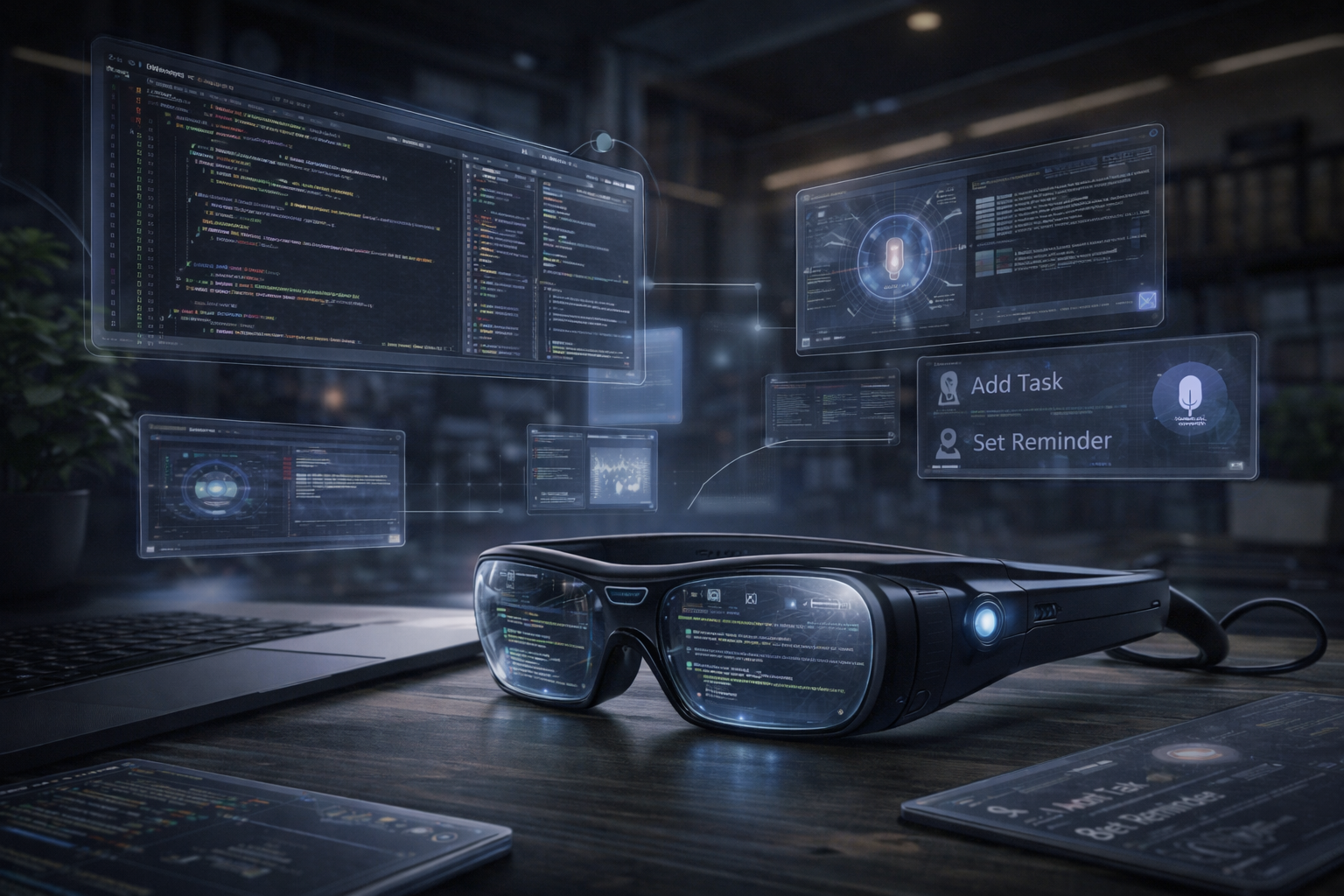
The relentless dance of "Alt-Tab" is a silent assassin of your flow state. For software engineers, constantly swapping between IDEs, documentation, terminal windows, and Slack isn't just a minor annoyance - it is a major cause of context switching productivity loss. In the pursuit of deep work, the traditional monitor has become a bottleneck.
The shift toward spatial computing for software engineering introduces a new paradigm: the "Third Interface."
This isn't about throwing away your laptop. Instead, it’s about moving critical information to where your eyes already live. By using ambient computing for deep work, developers can now keep their heads up, integrating digital tools directly into their physical workspace without breaking focus.
Smart glasses are evolving from niche gadgets into high-performance tools. For a developer, the goal is to reduce cognitive load.
If you are looking for the best smart glasses for developers 2026, here is how they actually change your workflow:
- The Ultimate Portable Monitor: Use AR to create virtual multi-monitor setups.This gives you a mobile workstation that isn’t limited by physical screen size. Whether you are in a cafe or at an airport, you can have a dedicated terminal window or system log floating in your peripheral vision.
- AR Documentation Overlay for IDEs: Imagine API references, Stack Overflow threads, or Kubernetes structures projected as a subtle overlay. This hands-free coding assistant ensures documentation is accessible with a quick glance, keeping your hands on the keyboard and your mind on the logic.
- POV Bug Reporting for Hardware Developers: For those in IoT or robotics, debugging requires moving around.
- POV video streaming for pair programming and real-time sensor data overlays allow hardware devs to see logs directly on the physical device they are fixing.
- Voice-First Task Management: Using on-device AI inference for smart glasses, you can dictate notes, set reminders, or capture code snippets via voice. This eliminates the need to stop coding just to update a Jira ticket.
Transitioning to wearable interfaces requires a fundamental shift in how we build software. The next frontier isn’t just mobile or web; it’s about building AR apps for AI glasses that respect the user’s field of view.
If you are a creator looking at an Open SDK for smart glasses, these are the technical pillars you need to know:
- Platform Flexibility: A developer-first approach requires an SDK that allows for deep integration with Linux or Android-based utilities.
- High-Performance Hardware: To handle complex spatial UI design for smart glasses, you need low-latency processing.
Systems powered by the Qualcomm Snapdragon AR1 Gen 1 are the current benchmark for this performance.
- Glanceable UI: Moving away from "clicks and scrolls" toward "glances and voice commands" means designing high-contrast, simple information that doesn't distract the user.
A developer’s shift can last a long time. This is why "long-duration comfort" is the most important engineering goal. Lightweight AR glasses for long-duration coding must balance weight and heat so they don't become uncomfortable after an hour.
In an office setting, AI wearable privacy is also a top priority. Features like visible recording lights and privacy-compliant wearable cameras ensure these tools are safe for secure environments and meet DPDP regulations. Combined with directional audio APIs, you can hear private notifications without needing bulky headphones.
As India-made XR hardware for enterprise grows, we are seeing a shift away from imported consumer gadgets. This evolution is a major reason why smart glasses for developers are taking off in India’s tech scene, as local innovation focuses on 'predictable' hardware—tools that prioritize actual utility over flashy features.
Whether you are looking for the best smart glasses for VS Code integration or a standalone AI sidekick, moving to a heads-up, spatial workflow is the next logical step in software development.
Qualcomm Technologies: Snapdragon AR1 Gen 1 Platform Product Brief
The Khronos Group: OpenXR 1.1 Specification
Qualcomm Developer Network: Snapdragon Spaces XR Developer Platform
Microsoft Research: Today was a Good Day: The Daily Life of Software Developers
Microsoft Research: Toward Characterizing the Productivity Benefits of Very Large Displays
ACM/IEEE (LMU Munich): Significant Productivity Gains through Programming with Large Language Models
EY India: Decoding the Digital Personal Data Protection (DPDP) Act, 2023
Mitsui & Co. Global Strategic Studies: How Developments in Smart Glasses are Transforming Society

By signing up, you are agreeing to Terms of service and Privacy policy.
You can withdraw consent at any time.
.svg)
.svg)
.svg)

.png)
