

.svg)
The global conversation surrounding India’s technology sector has long been dominated by its prowess in software services and application development. However, as we transition from the era of mobile computing to the era of spatial computing, a fundamental infrastructure gap has emerged. In the context of Extended Reality (XR), a critical truth remains: software is a guest, and hardware is the host.
For an ecosystem as vast and strategic as India’s to be sustainable, the hardware cannot remain a variable or a third-party dependency. It must be the foundation. At QWR, the decision to engineer and manufacture hardware locally was not a matter of sentiment; it was a strategic response to the specific constraints and requirements of the Indian industrial and educational landscape.

In any computing paradigm, the "physical layer" dictates the boundaries of what is possible. When a nation relies on imported hardware, it essentially rents space on a foundation governed by foreign data policies, external supply chains, and standardized global specifications.
By choosing to build the host layer in-house, QWR eliminated the risks inherent in "borrowed foundations." This vertical integration ensures that the entire stack is optimized for a specific set of high-stakes use cases. In sectors where precision and uptime are non-negotiable, owning the hardware is the only path to operational stability. It allows for a level of control over latency, security, and power management that "off-the-shelf" solutions simply cannot provide.
A significant challenge with global XR hardware is that it is frequently designed for "ideal" environments—typically climate-controlled offices or consumer living rooms.
These designs often fail to account for the environmental and ergonomic realities of the Indian landscape.
- Thermal and Environmental Resilience: Industrial training in India often takes place in non-standardized environments, ranging from rural vocational labs to high-temperature workshops. Locally engineered hardware is built to perform reliably under these thermal stresses, ensuring that a training session in a polytechnic in Rajasthan is as stable as one in a corporate office in Bangalore.
- Ergonomic and Demographic Alignment: Ergonomics are not universal. By designing hardware locally, it is possible to focus on human factors—such as weight distribution, facial interface geometry, and fit—that are specifically aligned with the Indian user base. This reduces fatigue and increases the "time-on-task" for learners and professionals.
- The Proximity Advantage: Establishing an R&D and manufacturing presence in a hub like Pune creates a compressed engineering feedback loop. In a traditional import model, hardware iterations take months or years. By localizing the process, the time between identifying a technical requirement and deploying a hardware solution is governed by physics and logic, not international shipping lanes.
As spatial computing moves into sensitive sectors such as Defense, Healthcare, and Government-led education, data security shifts from a feature to a foundational requirement. Many global XR devices are inherently cloud-tethered, requiring constant communication with foreign servers for telemetry, spatial mapping, and user analytics.
For the Indian Army or a national skill-building initiative, this creates a significant security liability. Indigenous manufacturing is the only verifiable way to ensure Data Sovereignty. By building the hardware and the operating system locally, QWR provides a closed-loop system where sensitive training data and spatial maps remain within national borders. This architectural choice is essential for building the institutional trust required to scale XR at a national level.
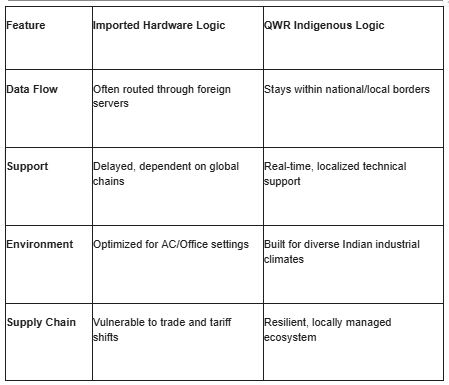
The global XR market is often bifurcated into high-end consumer gadgets and expensive enterprise prototypes. QWR has consciously bypassed the "want" market of consumer entertainment to focus on the "need" market of industrial and educational infrastructure.
India faces a unique challenge: the need to skill and upskill millions of individuals across diverse geographies. With over 14,000 ITIs and a massive demand for vocational training, the hardware used must be more than a peripheral; it must be a durable industrial tool.
Local manufacturing allows for a cost-to-value ratio that makes mass deployment economically viable. By bypassing the layers of import duties and international logistical friction, high-fidelity spatial computing becomes accessible to a student in a Tier-3 city or a technician in a remote factory.
Building hardware in India was not chosen because it was the easiest path, but because it was the only path that led to technical sovereignty. As spatial computing becomes the primary interface for how we work, learn, and defend, the reliance on imported "hosts" becomes a strategic bottleneck.
By setting the floor today, QWR ensures that the next generation of Indian intelligence is built on a foundation that we own, understand, and control. In the final analysis, true innovation cannot be imported—it must be engineered.
The decision to localize the hardware stack is rooted in three non-negotiable pillars of industrial logic:
- Technological Sovereignty: By moving beyond assembly to own the "Host" layer (IP, PCB design, and OS integration), QWR ensures that the foundation of Indian spatial computing is not subject to external dependencies or foreign data policies.
- Operational Resilience: Manufacturing within the Pune ecosystem enables a high-velocity feedback loop. This proximity ensures that hardware is
engineered for the thermal and ergonomic realities of the Indian industrial landscape, rather than generic global standards.
- Data Integrity: Indigenous manufacturing provides a verifiable, closed-loop environment. This is the only sustainable model for high-stakes sectors like Defense and Government education, where Data Sovereignty is a prerequisite for deployment.
- Economic Scalability: By streamlining the supply chain and eliminating international logistical friction, QWR facilitates the mass adoption of XR tools in "Need" markets, such as vocational training and industrial skilling, making world-class technology accessible at a national scale.

By signing up, you are agreeing to Terms of service and Privacy policy.
You can withdraw consent at any time.
.svg)
.svg)
.svg)

.png)
