

.svg)
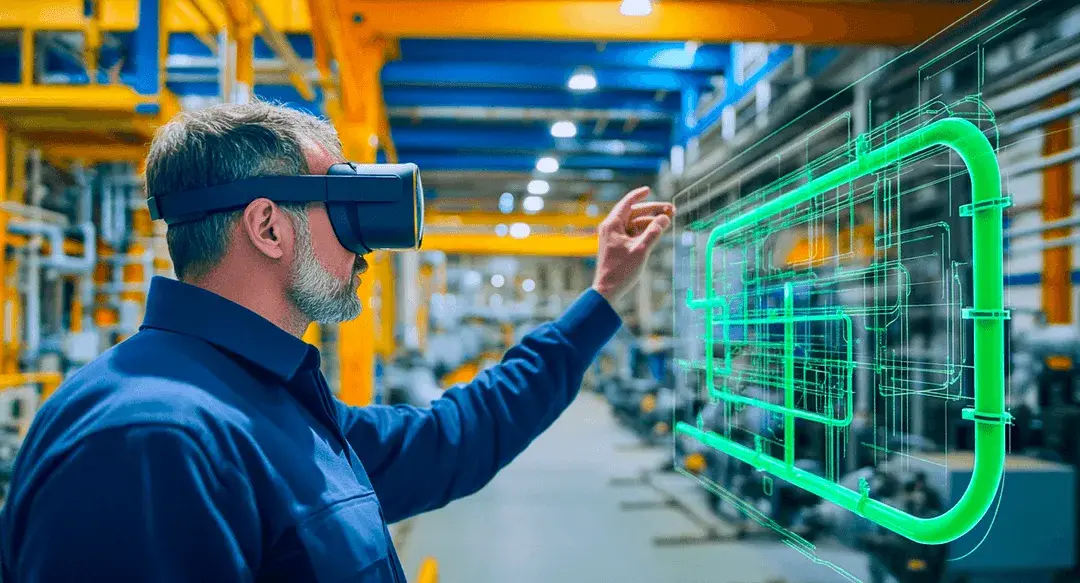
Virtual reality is often positioned as a breakthrough tool for enterprise training — immersive, repeatable, and scalable. In practice, however, VR adoption across enterprises remains uneven. Many pilots show early promise, only to stall before scaling. Headsets are purchased, tested briefly, and then quietly shelved.
This is not because VR as a medium doesn’t work.
It is because most VR headsets were never designed for training in the first place.
This piece examines why enterprise VR deployments struggle, how training use cases differ fundamentally from consumer VR, and what actually determines whether VR functions as a serious learning tool rather than a short-lived experiment.
On paper, VR aligns well with enterprise training requirements:
- Simulated environments reduce real-world risk
- Scenarios can be repeated consistently
- Learners can practice without consequences
- Progress can be measured and standardized
These advantages are already being applied across aviation, healthcare, manufacturing, safety, and technical skilling.
However, successful VR training depends far less on content alone than most teams expect. The hardware experience ultimately determines whether training can be executed reliably and repeatedly at scale.
Across industries, unsuccessful VR rollouts tend to show the same patterns:
- Short demo sessions work, longer sessions do not
- Users report discomfort or fatigue
- Devices require frequent adjustment or supervision
- Headsets are treated as “special equipment” rather than everyday tools
These issues are often attributed to user resistance or immature technology. In reality, the root cause is simpler: most VR headsets are optimized for entertainment, not sustained professional use.
Consumer VR headsets are typically designed for:
- Gaming and entertainment
- Short, high-intensity sessions
- Individual ownership
- Visual spectacle over endurance
Enterprise training environments, by contrast, require:
- Session lengths of 30–60 minutes or longer
- Shared devices across multiple users
- Predictable performance regardless of wearer
- Minimal setup friction
- Greater durability and operational reliability
This mismatch creates a series of practical failures when consumer hardware is repurposed for training.
Most consumer VR experiences are designed for sessions lasting 10–20 minutes. Training sessions routinely exceed this duration.
As session length increases, small design compromises compound:
- Front-heavy weight distribution causes neck strain
- Poor thermal management leads to heat discomfort
- Inaccurate IPD alignment reduces visual clarity
In training contexts, discomfort directly impacts learning outcomes. Users disengage, rush modules, or avoid repeat sessions altogether, reducing retention and effectiveness.
In entertainment VR, comfort is often treated as subjective. In enterprise training, comfort is operational.
Critical comfort factors include:
- Weight distribution, not just total weight
- Headset balance during standing or active tasks
- Facial interfaces suitable for repeated use
- Accurate IPD adjustment to minimize eye strain
When a headset requires frequent readjustment, training efficiency declines. Over time, this friction becomes a primary reason for abandonment.
Enterprise training environments frequently require users to:
- Read instructions and labels
- Identify components or interfaces
- Detect small visual cues
- Follow spatial or procedural sequences
Inconsistent resolution, optical distortion, or poor clarity increases cognitive load. Instead of learning the task, users expend effort compensating for hardware limitations.
For training, optics and display consistency matter more than raw graphical performance.
In enterprise settings:
- Devices are shared
- Users vary widely in height, vision, and experience
- Sessions run back-to-back
Headsets that work well for one user but require recalibration for the next slow down operations. Training hardware must behave predictably, regardless of who is wearing it.
Successful VR training deployments tend to share a common trait: the hardware was designed with training as the primary use case.
This shifts design priorities:
- Endurance over spectacle
- Stability over experimentation
- Comfort over compactness
- Control over novelty
When hardware intent aligns with training intent, VR becomes reliable, repeatable, and operational - effective precisely because it disappears into the workflow.
In India, enterprise VR training faces additional realities:
- Cost sensitivity at scale
- Highly diverse user profiles
- Infrastructure variability
- Long-duration, session-based skilling programs
Hardware designed for Western consumer markets often struggles under these conditions. As a result, Indian enterprises increasingly look for purpose-built training hardware rather than adapted consumer assumptions.
A growing segment of XR hardware development is beginning to approach VR from a training-first perspective.
Instead of asking how immersive a system can be, the guiding questions become:
- How long can a user wear the headset comfortably?
- How predictable is the experience across users?
- How easily can the device be deployed in real training environments?
This shift does not make VR more exciting. It makes it viable.
VR does not fail in enterprise training because the technology is immature.
It fails when:
- Hardware is optimized for the wrong use case
- Comfort is underestimated
- Session length is ignored
- Training realities are treated as edge cases
When these factors are addressed, VR stops being an experiment and begins functioning as infrastructure.
Enterprise training demands tools that disappear into the workflow. VR headsets designed primarily for entertainment rarely meet this requirement.
The future of VR training will be shaped not by the most powerful or visually impressive devices, but by those that prioritize clarity, control, and comfort over extended use. When VR hardware is designed with intent, training gains the reliability required to scale.

By signing up, you are agreeing to Terms of service and Privacy policy.
You can withdraw consent at any time.
.svg)
.svg)
.svg)

.png)
