

.svg)
- Market Explosion: India is now a global leader in wearable technology, with the market projected to reach ₹58,720 crore by 2025.
- Top Performers: Affordable smartwatches, TWS earbuds, and smart rings are dominating due to "Make in India" initiatives and budget-friendly pricing.
- Next-Gen Innovation: AI smart glasses and AR heads-up displays are transforming workplace productivity and hands-free digital interaction.
- Core Challenges: Adoption is hindered by limited battery life, clinical data inaccuracy, and rising data privacy concerns.
- The Future: Success depends on shifting from assembly to deep-tech R&D, local sensor manufacturing, and expanding digital literacy into rural markets.
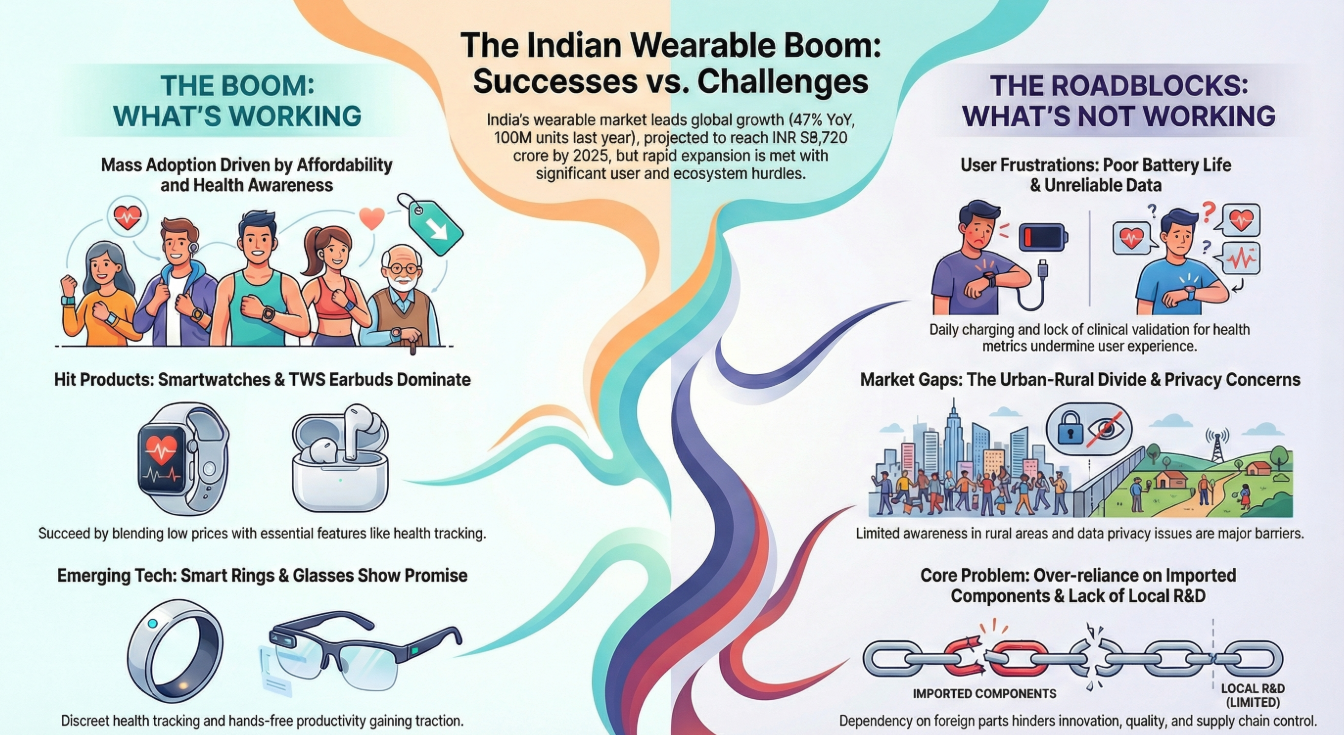
India's wearable tech market shows exceptional growth and might reach INR 58,720 crore by 2025. The country leads global wearable markets with an impressive 47% year-on-year growth last year. Indians bought about 100 million units, contributing significantly to the global sales of 492 million units.
Smart glasses stand out as the next breakthrough in wearable technology. These productivity-focused devices and heads-up wearable solutions are changing how people interact with digital information. AI integration has become widespread, with 70% of Indian wearables now featuring embedded AI. Smart and AI glasses offer immersive AR experiences that blend digital information with the real world. Yet some challenges persist in this growing market.
Our analysis breaks down the successes and failures in India's wearable tech ecosystem and why it happens. Tech enthusiasts and first-time buyers will find this guide helpful to direct them through this exciting but complex market.
Several key factors have created perfect market conditions for wearable technology to thrive in India. What started as a niche interest has now become mainstream.
A dramatic price drop in wearable devices has expanded the market substantially. Indian brands have disrupted the market by offering feature-rich devices at lower prices than international competitors. The government's "Make in India" initiative has encouraged local manufacturing to reduce import dependencies and cut costs. Companies can now develop products that match Indian consumer's priorities through local production. These products include regional language support and features suited to India's weather conditions.
India's young population has created an unprecedented need for wearable technology. Tech-savvy consumers under 30 years of age, who make up more than 50% of the population, embrace digital lifestyles naturally. This demographic sees wearables as essential lifestyle accessories that complement their smartphones. Remote work has made productivity glasses and heads-up wearable tech solutions popular among young professionals who want to streamline processes. AI integration in smart glasses draws this audience by offering new ways to interact with digital information while staying connected to the physical world.
Health consciousness among Indians has risen dramatically since the COVID-19 pandemic. This transformation has shaped the wearable tech market as consumers value devices that monitor vital health parameters. Smart watches with SpO2 monitoring, heart rate tracking, and sleep analysis have become popular choices. Healthcare providers now use data from wearable devices in patient care protocols to create a healthcare ecosystem. Continuous health monitoring without hospital visits appeals to consumers in urban and semi-urban areas. Health-tracking wearables are now fundamental to preventive healthcare practices.
These three factors are the foundations of wearable technology's continued expansion throughout India, especially in emerging categories like AI glasses and smart glasses.
The digital world of wearable tech is changing faster than ever, and some devices really stand out by giving Indian consumers real value. These success stories show how tech adapts to local needs and priorities.
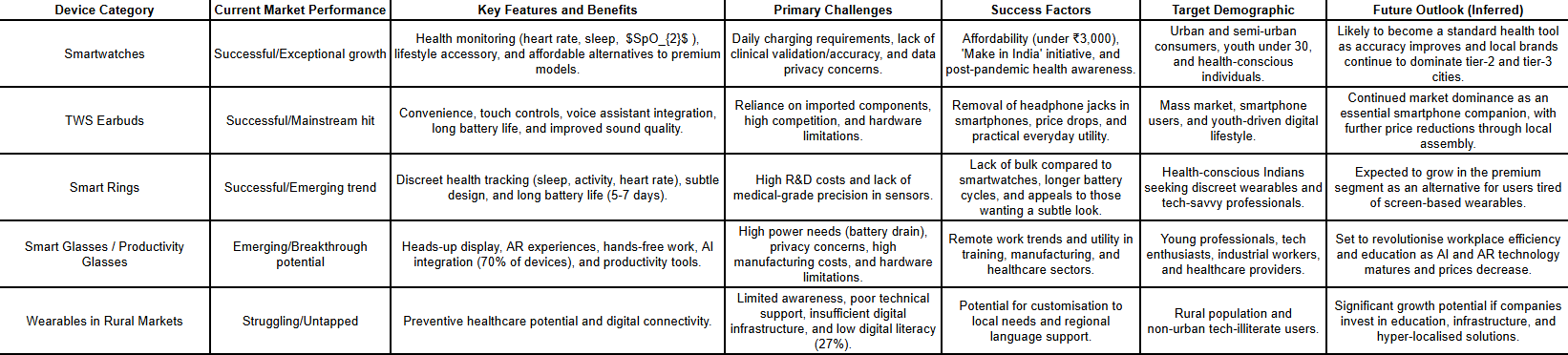
Indians love smartwatches that blend health monitoring with wallet-friendly prices. Local brands have grabbed much of the market by offering feature-packed alternatives to premium international models. These devices pack all the vital health metrics like heart rate monitoring, sleep tracking, and SpO2 sensors - features you'd only find in expensive models before.
Price matters a lot, and you can now find quality options under ₹3,000. The smartwatch revolution has spread beyond big cities into tier-2 and tier-3 towns, making health tech available to more people.
True Wireless Stereo (TWS) earbuds are everywhere in India. We adopted them because they're practical for everyday use. People love them for their convenience, better sound quality, and prices that keep getting better.
Indian users value features like touch controls, voice assistant integration, and long battery life. The trend picked up speed when smartphones dropped headphone jacks, and TWS earbuds became a must-have rather than a luxury.
Smart rings are the new trend catching on with health-conscious Indians who want discreet wearables. These tiny devices pack impressive tech into a simple design. They track sleep quality, activity, and heart rate without a smartwatch's bulk.
The battery lasts 5-7 days, which users love because they're tired of daily charging. Yes, it is their subtle design that makes them perfect for tracking health without getting in the way of daily life.
Smart glasses and heads-up wearable tech are changing how Indians work with digital information. These clever devices show important info right in front of your eyes, letting professionals in all types of industries work hands-free.
AI glasses help with training, manufacturing, and healthcare in India. The tech gets better and cheaper, which helps revolutionize workplace efficiency. These aren't just fancy gadgets - they're tools that boost productivity by blending augmented reality with practical uses.
The impressive growth of wearable technology in India faces several challenges that affect user experience and slow down wider adoption. These pain points create chances for breakthroughs in this growing market.
Battery performance remains the Achilles' heel for most wearable devices. Many smartwatches need daily charging, which disrupts continuous health monitoring. This problem becomes worse with productivity glasses and heads-up wearable tech because their power needs are much higher. Hardware limitations force manufacturers to choose between functionality and battery life. This results in devices that either drain quickly or come with fewer features.
Health tracking features help sell devices, but their readings often fall short of medical standards. Many fitness trackers and AI glasses in India lack proper clinical validation. This makes their health data unreliable for medical decisions. The gap between consumer-grade monitoring and medical-grade precision stays substantial. Users who depend on these devices for health insights often have a false sense of security.
Privacy concerns have grown as wearables collect more intimate data. Users worry about how companies store, process, and share their personal health information with third parties. The lack of clear data policies and reliable security measures has damaged trust. This especially affects privacy-conscious consumers who might otherwise try smart glasses and other advanced wearables.
We benefited from the wearable tech revolution mostly in urban India, while rural markets remain largely untouched. Rural regions lag behind metropolitan areas with limited awareness, poor technical support, and insufficient digital infrastructure to use these devices properly. This untapped demographic offers great potential for companies ready to invest in education and customized solutions for non-urban consumers.
Core issues behind India's wearable tech challenges stem from fundamental gaps in the ecosystem.
India struggles with a shortage of full-stack hardware expertise. Muse Wearables cofounder KLN Sai Prasanth explains, "India has strong talent but limited experience in full-stack hardware and manufacturing because very few companies build end-to-end products here". This gap in manufacturing results in lower quality productivity glasses and other wearables. Companies must invest heavily to develop these capabilities from scratch.
"The biggest gaps today are in advanced sensor research, algorithms, and machine learning". This lack of R&D affects the accuracy and reliability of data that wearable devices collect. Most biosensors are still in development stages and haven't reached the sensitivity, selectivity, and accuracy needed to monitor biomarkers continuously.
Only 27% of rural users know how to use digital technology. This knowledge gap limits adoption by a lot, especially in non-urban areas where people lack health literacy and awareness about wearable technology benefits.
Local production has increased, but India still depends heavily on Chinese components. Medical gadget imports make up 75-80% of the country's total. Most Indian wearable brands rely on Chinese integrated design houses to design and test their products.
The Indian wearable technology market sits at a turning point. The market shows remarkable growth and state-of-the-art developments, yet faces real challenges that shape its development. Smartwatches and TWS earbuds have become mainstream hits because they're affordable, practical, and track health metrics well. Smart rings and productivity glasses also show promise as emerging categories.
These wins don't tell the whole story though. Users still get frustrated with battery limitations, and health metrics don't always hit the mark. Privacy concerns make many potential buyers think twice. The biggest problem remains the gap between urban and rural areas that keeps these devices from reaching everyone.
Building a stronger ecosystem needs work to be done. India needs to build expertise in hardware manufacturing instead of depending on imported parts. More investment in AI and sensor research will help fix accuracy issues. Digital literacy programs could help spread awareness, especially in rural communities.
Smart technology's impact reaches way beyond the reach and influence of city limits. Smart glasses that add digital information to what we see are just the start. These devices will change healthcare, education, and workplace efficiency in every corner of India.
Wearable tech has found its place in India. Some segments thrive while others don't deal very well with challenges, but growth continues steadily upward. Indian companies will likely create more specialized products that fit local culture and needs in the coming years. This shift will help build India's tech capabilities. As this development continues, wearables will move from cool gadgets to become tools that boost daily life for millions of Indians.
Wearable tech adoption challenges and opportunities in India
https://www.entrepreneur.com/en-in/technology/indias-next-wearable-tech-frontier-challenges-and/500635
Wearable devices, health monitoring, and real-world limitations
https://pmc.ncbi.nlm.nih.gov/articles/PMC10708748/
Consumer technology growth driven by smartphones and wearables in India
https://www.exchange4media.com/marketing-news/consumer-tech-focusing-on-smartphones-wearables-in-india-146414.html
Wearables manufacturing shift and production growth in India
https://economictimes.indiatimes.com/industry/cons-products/electronics/growing-wearables-production-in-india-bleeds-china-units/articleshow/101264941.cms
India smart wearable market size, trends, and forecasts
https://www.researchandmarkets.com/report/india-smart-wearable-market
India wearable technology market outlook and growth analysis
https://www.imarcgroup.com/india-wearable-technology-market
Smart wearable market growth and segmentation in India
https://www.mordorintelligence.com/industry-reports/india-smart-wearable-market
Fitness and health-focused smart wearables adoption in India
https://www.kenresearch.com/india-smart-wearables-for-fitness-health-market
Global wearable technology direction and context
https://www.grandviewresearch.com/industry-analysis/wearable-technology-market
QWR Smart Glasses
https://www.questionwhatsreal.com/products/HUMBL

By signing up, you are agreeing to Terms of service and Privacy policy.
You can withdraw consent at any time.
.svg)
.svg)
.svg)

.png)
