

.svg)
The COVID-19 pandemic has pushed India's mental health problems to new heights, making VR therapy a fast-growing solution. The country faces major challenges with nearly 29 million people struggling with alcohol dependency (2.7% of the population). Virtual reality therapy brings a fresh approach to tackle these rising mental healthcare needs.
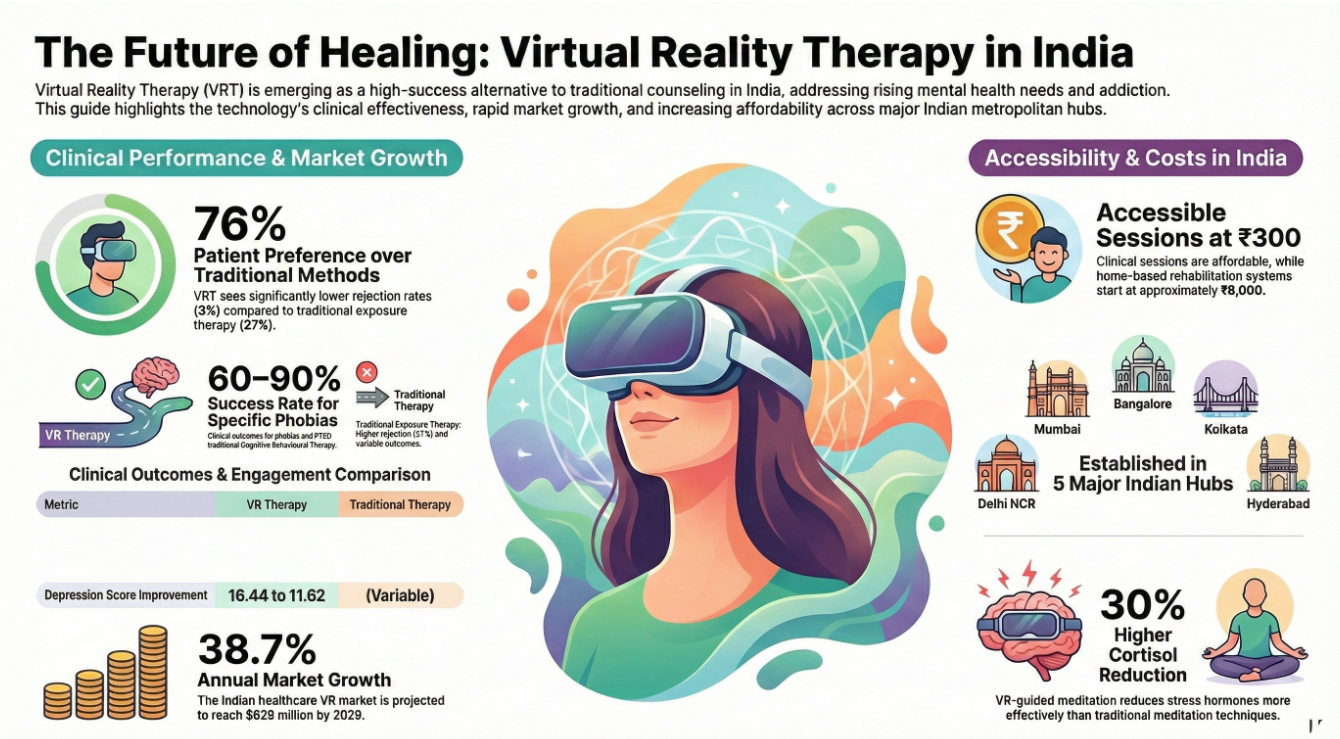
Research shows VR therapy matches the success rates of Cognitive Behavioral Therapy and keeps more patients engaged in treatment. The technology helps patients recover from neurological issues, supports rehabilitation, and manages pain effectively. The healthcare VR market reflects this potential - experts predict it will surge at 38.7% CAGR and reach $628 million by 2029.
This piece walks you through VR mental health therapy basics. You'll learn how it works, what conditions it treats, and its costs in India. We'll help you decide if this breakthrough treatment suits your needs. The guide answers key questions about immersive healthcare and XR rehabilitation to give you a clear picture of this innovative wellness approach.
VR therapy stands out as a trailblazing approach that lets patients interact with computer-generated environments through specialized headsets. This technology creates immersive experiences that feel remarkably real. Patients stay completely safe throughout their therapeutic journey.
Virtual reality therapy, also known as virtual reality exposure therapy (VRET), takes patients into controlled digital environments designed to trigger specific emotional responses. Traditional talk therapy asks clients to imagine scenarios. VR therapy, however, lets patients experience situations firsthand. To cite an instance, see someone with a fear of flying who can sit in a virtual airplane cabin, hear engine sounds, and practice calming techniques while staying physically safe.
This therapeutic method follows a well-laid-out program. The intensity of virtual scenarios increases gradually over time. Patients become desensitized to their fears and experience reduced anxiety responses as treatment progresses. Each patient receives individual-specific experiences based on their specific needs.
Your brain cannot tell virtual experiences from real ones - this makes VR therapy work. Patients show genuine emotional and physiological responses in virtual environments that match real-life situations. This deep immersion creates what experts call "presence" – the psychological feeling of being physically situated in the virtual world.
Research shows that stronger presence in VR helps patients progress faster and participate better in therapy. Many VR systems can track heart rate and sweating during sessions. These measurements give therapists live feedback about patient anxiety levels.
VR setups of different types serve patients across India:
- Fully immersive systems use high-end VR headsets that create complete sensory experiences, often found in specialized clinics like Rewin's network, which is expanding from 10 to 150 clinics across India
- Mobile-based programs offer simpler applications that work on portable devices, making them available to more people
- Telehealth VR solutions help patients receive therapy remotely while staying connected with their therapist
Sparshmind Innovations in India develops custom VR therapy programs for specific conditions and patient needs. HCAH SuVitas Hyderabad pioneered this technology's adoption in India. Now VR therapy serves patients at centers in Delhi NCR, Mumbai, Bangalore, Kolkata, and Hyderabad.
VR therapy works well for many mental health conditions. Clinical studies back up its effectiveness across various psychological challenges.
VR exposure therapy (VRET) shows remarkable results in treating specific phobias. Studies confirm that VR therapy for flight phobia works well for up to 6 months after treatment. The results match those of in-person therapy for treating acrophobia (fear of heights). Patients prefer VR therapy by a wide margin (76%) over traditional exposure therapy. The rejection rates are much lower too - just 3% compared to 27% for traditional methods.
VR therapy helps reduce PTSD symptoms, with benefits lasting 3-6 months after treatment. The combination of VR and Cognitive Behavioral Therapy (CBT) works well for depression, especially when you have anxiety symptoms too. A study found that depression symptoms dropped from an average score of 16.44 to 11.62 after ten sessions.
VR cue exposure therapy helps people with substance use disorders by letting them face triggers in safe, controlled settings. Studies show that VR therapy helps reduce cravings and relapse rates while improving self-control. People stick with their 12-week psychosocial treatment programs better when using VR therapy compared to other methods.
Peaceful VR environments help lower stress levels through calming nature scenes and guided mindfulness exercises. VR-guided meditation can cut cortisol levels by about 30% more than traditional meditation. These relaxation techniques also help reduce anxiety before, during, and after medical procedures.
VR creates safe spaces for people with Autism Spectrum Disorder (ASD) to practice social interactions without real anxiety. Users can gradually work up to challenging situations like using public transport, shopping for groceries, or visiting doctors. Research proves that VR helps improve job interview skills, social abilities, and confidence in adults with ASD.
VR therapy is becoming more available for mental health treatment in India, though prices and access vary across regions.
Indian clinics charge different rates for VR therapy based on their facilities and treatment types. A 45-minute session costs about 300 rupees, and patients start seeing results within weeks. Medical centers that buy professional VR rehabilitation systems pay between ₹2,00,000 to ₹10,00,000 for complete setups.
Many facilities now run VR-enhanced group therapy sessions as an economical option instead of one-on-one treatments. This helps cut down costs and lets patients support each other during their treatment.
VR therapy services are mostly found in big cities right now. HCAH Rehabilitation and Recovery Centers provide VR therapy in:
- Delhi NCR
- Mumbai
- Bangalore
- Kolkata
- Hyderabad
Trained physiotherapists watch over all sessions at these centers and adjust the difficulty based on each patient's needs.
Insurance plans in India rarely cover VR therapy. But new payment options are making this technology more available. Clinics can rent older VR headset models that work just as well for treatments at lower costs.
Personal VR rehabilitation systems start at about ₹6,000, making home therapy more affordable. Clinic treatments still offer better care with professional supervision.
Platforms like Rehametrics help healthcare workers provide physical and cognitive therapy both in clinics and at home. Patients can pick what suits their schedule, movement ability, and budget best.
Research shows that VR therapy produces remarkable results. Success rates range from 60-90% for specific phobias. This technology isn't right for everyone seeking mental health treatment.
VR exposure therapy matches or surpasses traditional methods. Patients with anxiety disorders report major improvements after each session. A newer study, published in Lancet Psychiatry proved that automated VR treatment works for patients with psychosis. Patients with challenging psychological problems experienced the best results.
The therapy works well, but some people need to be careful:
- People with seizure disorders or epilepsy
- Those with severe vestibular problems or motion sickness
- Individuals with acute psychosis or severe dissociation
- Patients who went through eye surgery recently
Cybersickness affects about 5-10% of users, making it the most common side effect. Users experience nausea, dizziness, disorientation, and fatigue. Physical risks aren't the only concern - some patients see temporary spikes in anxiety (3.8%). Virtual experiences can trigger emotional distress if maladaptive cognitions aren't handled properly.
VR therapy matches traditional approaches in effectiveness and shows better retention rates. Patients seem to prefer VR methods - a study found that 76% of participants liked virtual reality exposure better than conventional therapy.
India's mental healthcare sector has made VR therapy a groundbreaking treatment option. This piece highlights how VR technology creates immersive environments that help treat mental health conditions while keeping patients safe. Success rates ranging from 60-90% for specific phobias show why this approach deserves a closer look.
Patient data reveals a strong preference for VR therapy over traditional methods, with 76% favoring it and fewer patients rejecting treatment. These numbers, combined with outcomes matching or exceeding conventional therapy, make VR an exciting treatment choice for Indians seeking mental health support.
Professional VR therapy services have become accessible to more people in Delhi NCR, Mumbai, Bangalore, Kolkata, and Hyderabad. Home-based options starting at ₹6,000 now help patients who can't visit specialized clinics regularly.
VR therapy doesn't work for everyone though. Patients with seizure disorders, severe vestibular problems, acute psychosis, or those who had recent eye surgery should be careful. Cybersickness affects about 5-10% of users, but these symptoms usually fade quickly.
VR therapy's growth in India shows our need for state-of-the-art mental healthcare solutions. The healthcare VR market projects a soaring 38.7% CAGR by 2029, pointing to a bright future. People struggling with anxiety, phobias, PTSD, depression, or addiction might find VR therapy a valuable part of their healing experience. Sometimes the most effective solutions come from unexpected places – even virtual ones.
PubMed Central – VR in Mental Health (Systematic Evidence Review)
https://pmc.ncbi.nlm.nih.gov/articles/PMC7366939/
PubMed Central – VR Exposure Therapy Outcomes
https://pmc.ncbi.nlm.nih.gov/articles/PMC7324842/
PubMed Central – Clinical Applications of VR in Psychiatry
https://pmc.ncbi.nlm.nih.gov/articles/PMC10557052/
PubMed Central – VR Interventions for Psychological Disorders
https://pmc.ncbi.nlm.nih.gov/articles/PMC11323791/
PubMed Central – VR and Anxiety Disorders Research
https://pmc.ncbi.nlm.nih.gov/articles/PMC10199391/
PubMed Central – VR-Based Mental Health Therapy Evidence
https://pmc.ncbi.nlm.nih.gov/articles/PMC7190243/
PubMed Central – VR for PTSD and Trauma Care
https://pmc.ncbi.nlm.nih.gov/articles/PMC7468638/
PubMed Central – Latest Clinical Findings on VR Therapy (2025)
https://pmc.ncbi.nlm.nih.gov/articles/PMC12016277/
Frontiers in Virtual Reality – VR Clinical Research (Peer-Reviewed)
https://www.frontiersin.org/journals/virtual-reality/articles/10.3389/frvir.2023.1256641/full
Frontiers in Psychiatry – VR Treatment Outcomes (2025 Study)
https://www.frontiersin.org/journals/psychiatry/articles/10.3389/fpsyt.2025.1553290/full
MDPI – Journal of Clinical Medicine (VR & Mental Health Study)
https://www.mdpi.com/2077-0383/13/21/6435
Taylor & Francis (Journal of Psychosocial Nursing / Mental Health Research)
https://www.tandfonline.com/doi/full/10.1080/01612840.2023.2190051
NIHR (National Institute for Health and Care Research – UK Government)
https://www.nihr.ac.uk/news/landmark-clinical-trial-shows-benefits-virtual-reality-treatment-severe-psychological-problems
Mary Ann Liebert Publishers – Peer-Reviewed Clinical Journal
https://www.liebertpub.com/doi/full/10.1177/29941520251394885

By signing up, you are agreeing to Terms of service and Privacy policy.
You can withdraw consent at any time.
.svg)
.svg)
.svg)

.png)
