

.svg)
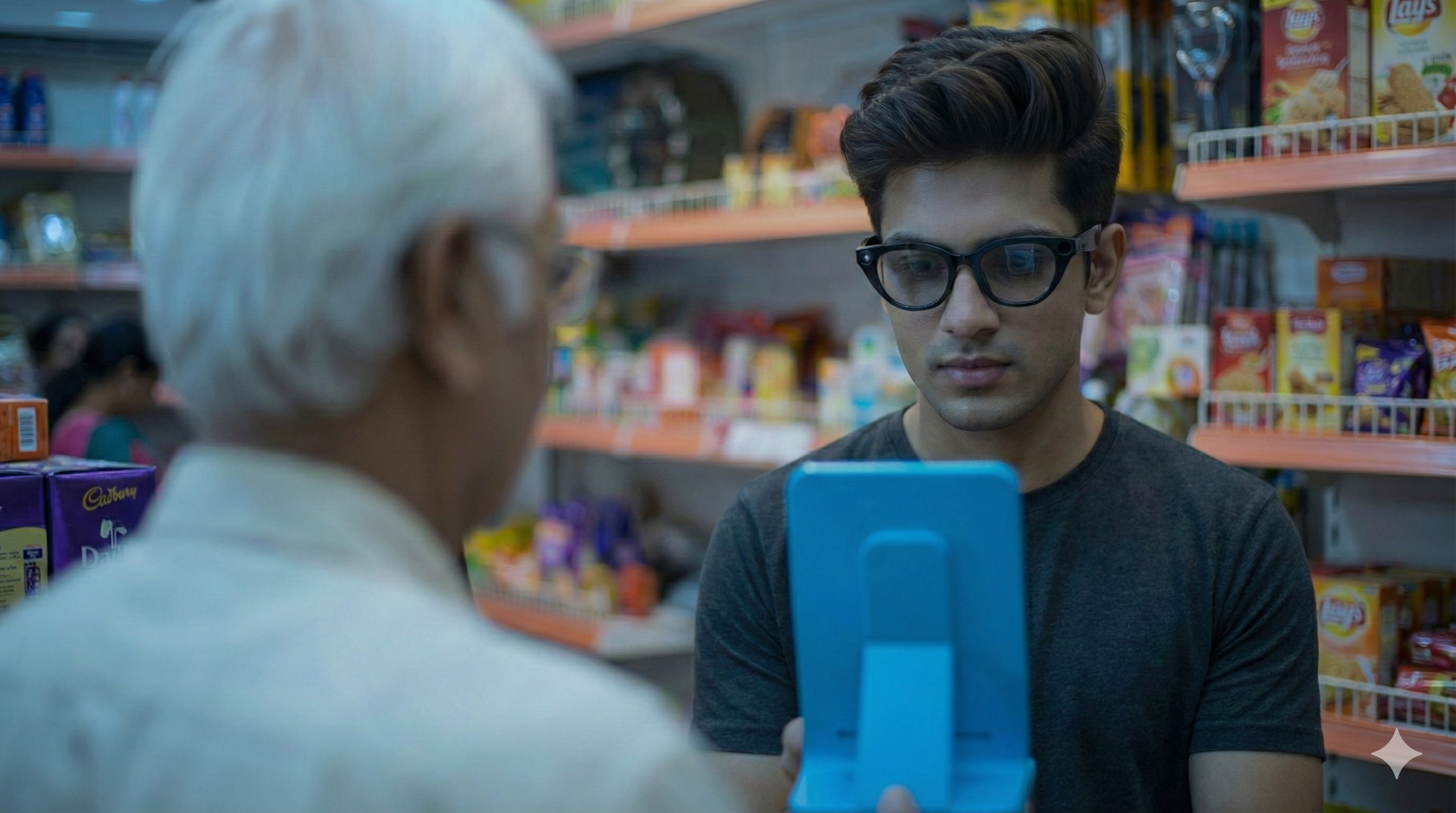
Unified Payments Interface (UPI) continues to dominate India’s digital payments landscape with over 16 billion monthly transactions, reshaping how consumers, enterprises, and governments transact every single day. As UPI Lite is set to sunset by March next year, the next chapter of UPI innovation focuses on something far more ambitious: bringing UPI to AI smart glasses and wearables, enabling truly hands-free, ambient payments that merge seamlessly into the user’s surroundings.
At the Global Fintech Fest 2025, NPCI demonstrated a breakthrough—UPI on smart glasses using voice commands, QR scans through built-in cameras, and ultra-fast confirmations, transforming how Indians will interact with payment systems in the coming decade. This is the first time UPI is extending beyond phones and smartwatches to AR glasses in India, unlocking a new era of wearable payment devices, voice-enabled UPI, and hands-free digital payments powered by AI and edge computing.
NPCI projects that by 2026, wearable-driven UPI volumes will grow multi-fold as smart glasses India adoption increases, especially across mobility, micro-retail, logistics, and field operations.
Traditional smartphone UPI requires multiple steps — unlock device → open app → align camera → enter PIN. In dynamic real-world environments, this flow becomes slow, attention-demanding, and often unsafe.
Smart glasses solve this by enabling:
1. Real-time QR Capture in Field of View
Users simply glance in the direction of the QR and say “scan,” making UPI hands-free and eliminating manual alignment.
2. Voice Command Payments
UPI voice command systems let users approve payments with a simple spoken confirmation, making contactless UPI through wearables faster and safer.
3. Multitasking Workflows
Hands remain free for handling inventory, steering a two-wheeler, assisting customers, carrying parcels, or performing repair tasks.
4. High-Frequency Micro-Transactions
UPI Lite historically optimized these, but with its deprecation, UPI 3.0 features and enhanced backend routing will take over, allowing lightning-fast payments even in congested networks.
Impact:
In high-footfall markets, metros, bus stops, and roadside stalls, hands-free UPI could boost transaction volumes by 20–30%, driven by convenience and speed.
UPI on smart glasses follows strict NPCI rules for secure, scalable integration.
Core components include:
1. Advanced On-Device Camera Systems
- QR scanning activates only when initiated by voice or gesture
- Prevents background or accidental scanning
- Maintains privacy and reduces computation load
2. Edge-Based Voice Processing
Smart glasses run on-device AI models for:
- Natural language interpretation
- Speaker ID matching
- Fraud-risk context checks
- Local token generation
This keeps sensitive data local and reduces reliance on cloud pipelines.
3. Seamless Connectivity Layers
Smart glasses interface with:
- UPI IDs
- Joint accounts and UPI Circles
- Linked bank accounts
- Companion smartphone apps
Bluetooth and Wi-Fi ensure smooth syncing even in low-signal areas.
4. NFC & IoT Payment Extensions
Future versions of wearable UPI aim to support:
- NFC tap-to-pay
- IoT-based automated toll payments
- Vending machine auto-payments
- Gesture-based confirmations
5. Compatibility with Wearable UPI Devices
The same framework will apply to:
- Smartwatches
- AR glasses
- AI smart glasses
- Future UPI wearable payment devices
At GFF 2025, RBI and NPCI emphasized that ambient payments—payments that “just happen” around the user—will define India’s digital future.
Because wearable UPI involves voice, camera and contextual data, security demands are significantly more complex.
Key protections include:
1. Multi-Factor Authentication
Low-value UPI operations are PIN-less
Larger transactions require voice match, facial checks, or OTP
Aadhaar-based voice biometric checks are being tested
2. No Sensitive Data Stored on Glasses
Smart glasses function as access devices, not storage devices.
All secure credentials remain inside:
The user’s smartphone
Secure availability zones
PCP-compliant token vaults
3. Dynamic Tokenization
Every transaction uses a fresh dynamic token, preventing replay attacks.
4. RBI-Compliant Data Localization
All payment data remains in India’s regulated cloud and bank servers.
5. Remote Wipe & Device Lock
If the glasses are lost, the linked UPI device can instantly revoke:
- Camera access
- Voice permissions
- Payment tokens
- Device pairing
6. Context-Aware Fraud Detection
AI evaluates:
- Ambient noise
- Location mismatch
- Voice spoofing
- Suspicious motion patterns
- Sudden transaction anomalies
This reduces fraud dramatically, especially compared to smartphones where shoulder surfing is a major concern.
India has become the global hub for digital payments innovation, and several factors accelerate the rise of UPI wearables and smart glasses with UPI:
1. Digital Payments India Ecosystem
Over 50 million merchants accept UPI, making ambient payment glasses instantly useful.
2. Hardware Becoming Affordable
Entry-level AI glasses and AR glasses are dropping towards the ₹15,000–₹20,000 range.
3. Rising Wearable Penetration
Smartwatches, fitness wearables, and now NFC wearables India products are hitting mass adoption.
4. Government-Led Innovation
- UPI 3.0
- UPI for feature phones
- UPI Lite X
- UPI for IoT devices
- UPI for EV charging
- NPCI wearable pilots
5. Enterprise Use Cases
Field workers, logistics teams, delivery fleets, and support staff benefit most from hands-free payments wearables.
NPCI forecasts that by 2027, UPI device integration across glasses, cars, and smartwatches will become as common as smartphone UPI today.
Smart glasses enabling UPI unlock broader possibilities:
1. Enterprise & Field Productivity
Technicians, mechanics, delivery agents, and retail staff can:
- Approve invoices
- Close service calls
- Collect payments
- Track orders without touching a phone.
2. Accessibility Enhancements
UPI voice-enabled smart glasses help:
- Senior citizens
- People with motor disabilities
- Visually impaired users
3. HCI Innovation Frontier
Voice + gesture + gaze + AR overlays =
the future of human-computer interaction for finance.
4. IoT & Ambient Automation
AI can auto-trigger payments for:
- Parking
- Tolls
- Metro gates
- Subscription vending machines
This could automate up to 40% of daily micro-payments.
Despite the promise, wearable UPI faces hurdles like high device costs (₹20,000+), uneven 5G coverage in rural areas, and privacy worries over biometric data storage. Battery life constraints during extended use and sensor inaccuracies in poor lighting or noisy environments pose additional risks, potentially causing failed authentications.
Mitigation strategies include:
- Subsidized enterprise bundles and EMI financing for affordability.
- Hybrid 4G/5G fallbacks and offline QR caching for connectivity gaps.
- UIDAI-compliant on-device biometrics with user-controlled data deletion.
- Regular OTA updates for sensor calibration and false-positive reductions.
NPCI's phased rollout prioritizes urban pilots before scaling, addressing these proactively.
Fintechs and OEMs can leverage NPCI's open APIs for custom integrations, from logistics dashboards to healthcare billing overlays. Enterprise pilots reveal ROI through 25% faster field transactions and reduced cash handling errors. Government incentives under Digital India encourage R&D, with sandbox testing for IoT-linked features like predictive vending payments.
Opportunities span:
- Custom voice models for regional languages.
- AR analytics for merchant QR optimization.
- B2B platforms linking glasses to ERP systems.
This ecosystem invites collaboration, accelerating innovation cycles.
NPCI envisions UPI wearables expanding to smartwatches, cars, and earbuds by 2027, with multi-modal auth blending gaze, gesture, and brainwave interfaces.
International pilots in UAE and Singapore adapt India's model, positioning UPI as exportable tech. Long-term, ambient ecosystems could automate 40% of micro-payments via AI context prediction.
UPI integration with smart glasses heralds an era of invisible, omnipresent payments, seamlessly weaving finance into India's vibrant daily life.
By overcoming traditional barriers with hands-free innovation, NPCI and RBI solidify the nation's fintech supremacy, promising inclusive growth and unprecedented efficiency.
This ambient revolution invites businesses and developers to pioneer the next digital frontier.
India TV News: UPI on wearable smart glasses (2025-10-07)indiatvnews
Outlook Money: UPI Lite wearable expansion (2025-10-07)outlookmoney
Indian Express: NPCI biometric wearable UPI (2025-10-07)indianexpress
BillCut: UPI wearables pilots and forecasts (2025-11-16)billcut
Paytm: RBI UPI innovations GFF 2025 (2025-10-07)paytm
Economic Times: UPI smart glasses rules (2025-11-13)economictimes.indiatimes
NDTV: Look, Speak, Pay UPI Lite (2025-10-06)ndtv
Free Press Journal: Hands-free UPI features (2025-10-06)freepressjournal
Business Today: RBI digital leaps GFF (2025-10-07)businesstoday
Outlook Money: UPI Lite glasses details (2025-10-07)outlookmoney

By signing up, you are agreeing to Terms of service and Privacy policy.
You can withdraw consent at any time.
.svg)
.svg)
.svg)

.png)
