

.svg)
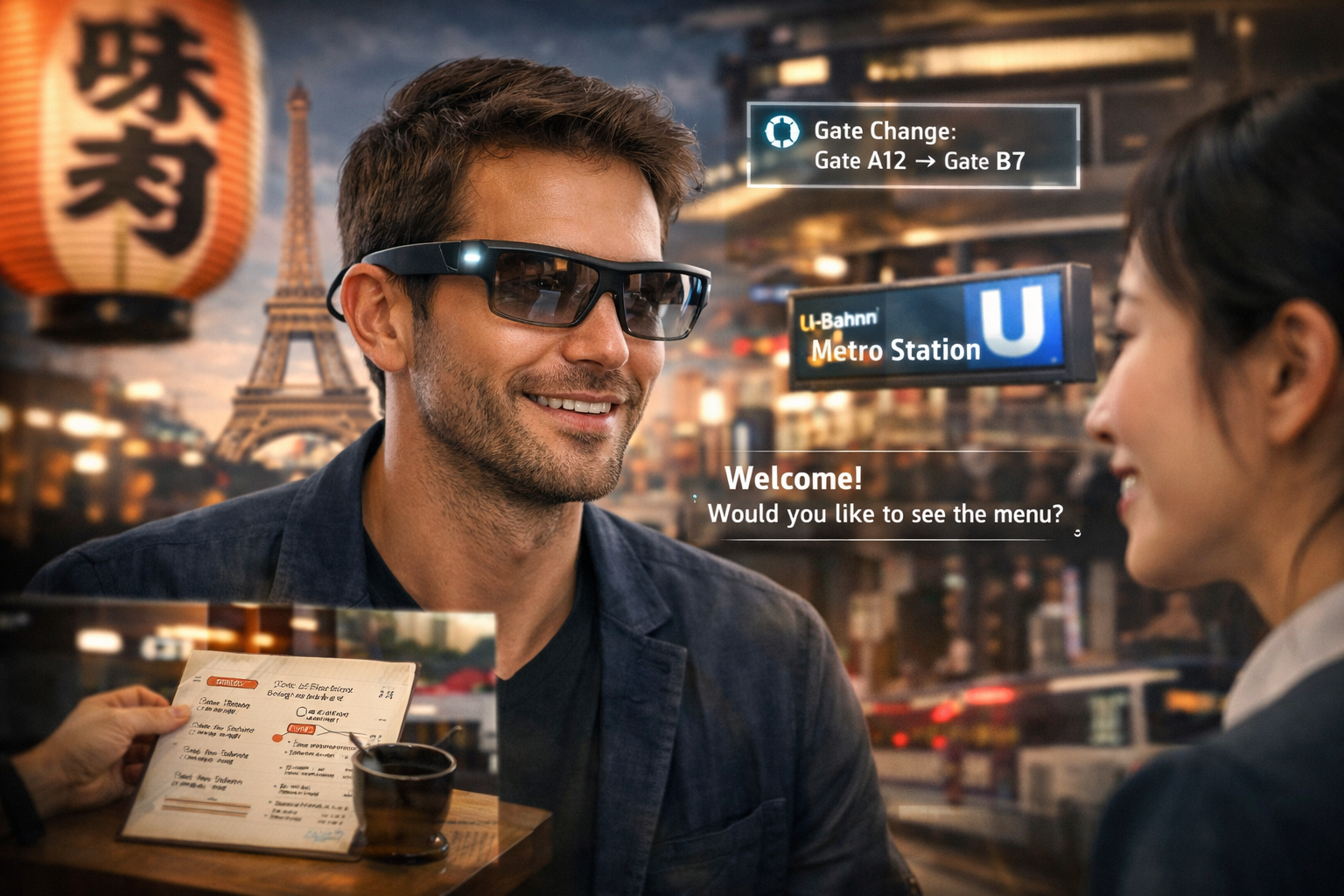
For decades, international travel was defined by the "Smartphone Stare." To navigate a Tokyo subway or a Parisian bistro, you had to break eye contact with the world, look down at a screen, and wait for a translation app to buffer. It was a barrier, not a bridge.In 2026, we are witnessing the "iPhone moment" for hands-free translation. As ambient computing wearables move from niche gadgets to essential travel gear, the way we experience foreign cultures is being rewritten.
The era of "Active Search"—where you manually type into a device—is being replaced by heads-up travel tech. In 2026, the best AI glasses 2026 provide a 360-degree understanding of your surroundings, offering information before you even realize you need it.
Whether it's a notification about a gate change at an airport or a historical fact about a monument you're passing, these smartphone alternatives ensure you stay present. You aren't "using a device"; you are simply living an enhanced version of your journey.
The "Hero" of the modern travel wearable is the integrated camera. While others see a camera merely as a tool for photos, we see it as the primary sensor for multimodal AI wearables.
Modern AI glasses with camera don't just record; they interpret. When you look at a handwritten menu in Kyoto, the visual translation technology identifies the dish, translates the ingredients, and cross-references them with your dietary preferences in milliseconds. This real-time object recognition turns a 4K camera into a bridge for human connection.
If the camera is the brain, then augmented reality (AR) is the interface. For the traveler, the waveguide HUD display acts as a silent supporting character.
Unlike bulky VR, transparent AR lenses allow for discreet live captioning glasses that project a heads-up translation overlay into the lower third of your vision.
This ensures you can read translated text while maintaining eye contact with the person speaking—the closest thing to a "Babel Fish" in your eye.
Research in human factors of AR highlights a major flaw in audio-only wearables: auditory interference. Trying to listen to a foreign speaker while an AI "whisperer" speaks into your ear causes immense mental fatigue.
Real-time linguistic processing via AR subtitles for real life solves this. By offloading the data to your eyes, your ears remain free to hear the speaker's emotion and tone. This dramatically reduces translation latency and eliminates the "brain lag" common in cognitive load in AI studies.
As we lean into secure AI camera glasses, the privacy debate has moved from "Is it recording?" to "Where is the data going?"
In compliance with India’s DPDP Act, the industry is shifting toward edge AI processing. By handling data locally on the device, privacy-friendly smart glasses ensure that your personal experiences stay yours. This data sovereignty in wearables is what makes 2026 the year we finally trust the technology on our faces.
The transition from handheld apps to AI-powered smart glasses represents the most significant shift in travel technology since the invention of GPS. By moving the "brain" of our devices into a multimodal camera and the "interface" into a discreet AR HUD, we are finally solving the age-old conflict between staying connected and staying present.In this new era of ambient computing, the focus has shifted from "using tech" to "experiencing the world."
With privacy-friendly edge AI and DPDP-compliant data sovereignty now at the core of wearable design, travelers can finally trust the technology they wear. As we embrace this borderless future, one thing is certain: the best way to see the world in 2026 is with your eyes wide open, free from the shackles of a 6-inch screen.
Gartner (2025): Strategic Impact of Multimodal AI on Consumer Wearables
MIT Technology Review (2026): The 10 Breakthrough Technologies: Why the Camera is the New Keyboard
IEEE Xplore: Linguistic AR: Low-Latency Subtitling in Wearable Displays
Wired: CES 2026: Why Smart Glasses are Finally Ready to Replace Your Phone
TechCrunch: Waveguides vs. Micro-OLED: The Battle for the Future of AR
Nature Electronics: Energy-Efficient Neural Processors for Wearable Language Models
CNET: The 2026 Travel Guide: Hands-Free AI and Live Translation
Forbes Tech Council: The Privacy Shift: Why Edge AI is Rebuilding Trust
Harvard Business Review: The Psychology of Cognitive Load and Workforce Augmentation
MeitY India: Guidelines for Data Sovereignty and the DPDP Act 2023

By signing up, you are agreeing to Terms of service and Privacy policy.
You can withdraw consent at any time.
.svg)
.svg)
.svg)

.png)
