

.svg)
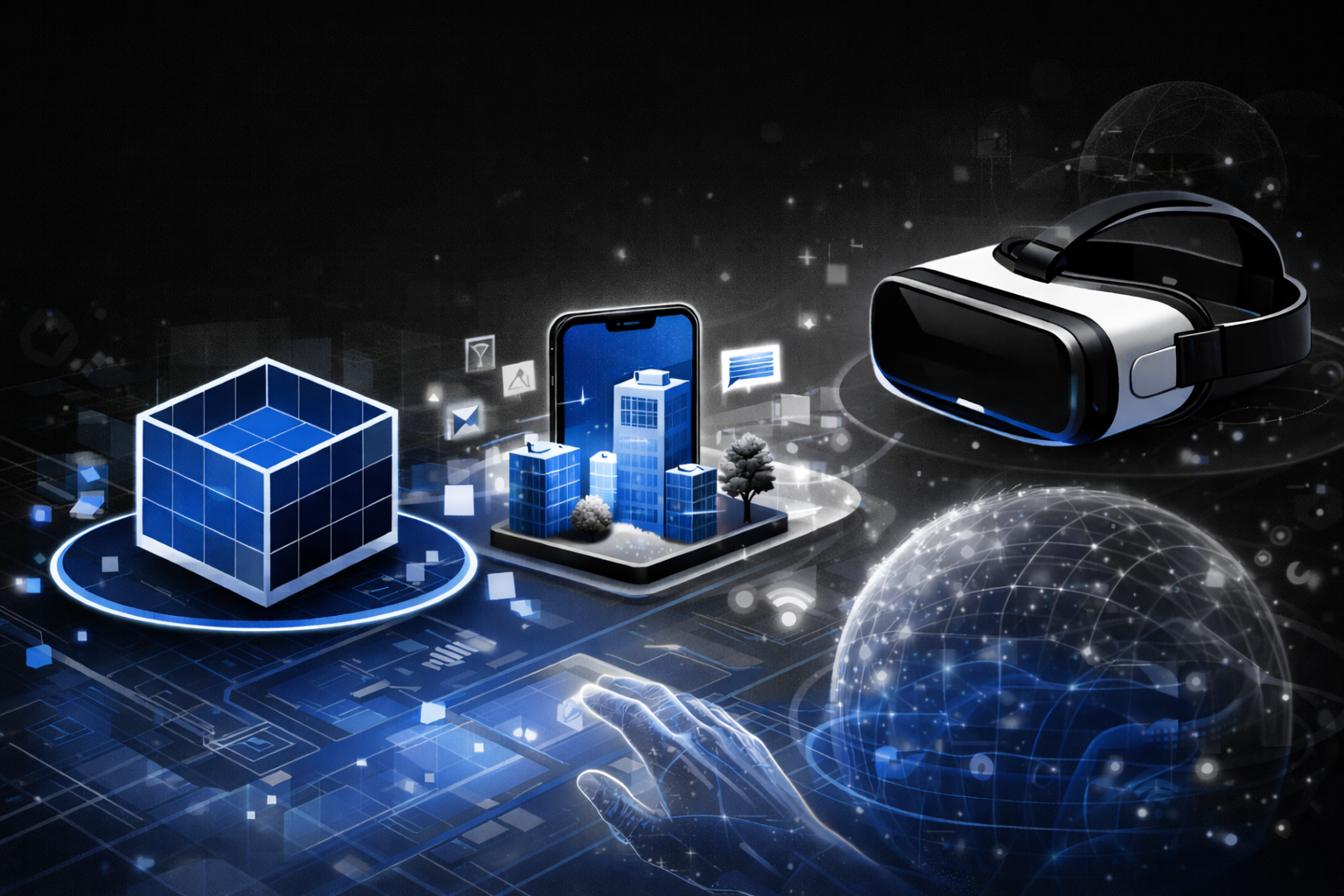
Apple's Vision Pro announcement in 2023 sparked an intense debate between spatial computing and VR AR technologies. Rectangular, flat screens have dominated our interaction with technology for decades, but the digital world now faces a fundamental change. Pokemon GO's massive success in 2016 brought Augmented Reality into mainstream consciousness. Spatial computing offers a detailed framework that allows virtual and ground elements to merge and interact dynamically.
Spatial computing combines physical and digital realities to create a user-friendly and immersive experience. Virtual Reality completely immerses users in computer-generated environments, while spatial computing serves as the foundation for advanced AR experiences, virtual reality, mixed reality, and extended reality (XR). Users can interact with their surroundings through AR glasses and VR headsets in ways that seamlessly blend digital and physical worlds. This technology points to a future where the internet extends beyond pocket devices and becomes part of the world around us.
Our next section will examine the main differences between these technologies and their real-life applications to help determine which solution best fits your organization's requirements.
Technology experts need clear definitions to understand what sets spatial computing apart from regular VR and AR experiences.
Spatial computing works as the basic technology stack that lets computers understand and interact with three-dimensional space. Most technologies focus on visual experiences, but spatial computing goes further. It creates a detailed framework that helps machines see, understand, and direct themselves in the physical world.
The technology stack combines computer vision, simultaneous localization and mapping (SLAM), depth sensing through LiDAR or stereoscopic cameras, spatial mapping, and gesture and gaze tracking.
Spatial computing builds the core engine that drives immersive experiences through its ability to understand surroundings and respond to context.
AR changes how we see things by adding digital information - images, text, or 3D models - to the real world without replacing it.
The physical world stays in focus, just with added digital layers for context. People experience AR through smartphones, tablets, or transparent glasses that mix what they see around them with computer-generated content.
AR has ground applications in retail, education, and navigation. Users can see products in their space before buying or get live directions through mobile mapping apps.
VR takes a different approach by creating fully immersive digital worlds that replace your physical surroundings. Head-mounted displays block out the real world and transport users to computer-generated landscapes for gaming, training, or virtual tourism.
VR systems create realistic images and sounds that make you feel physically present in a virtual world. Users can look around artificial worlds, move within them, and interact with virtual objects.
The main difference lies in their scope and purpose. XR (Extended Reality)—which covers VR, AR, and Mixed Reality—focuses on accessible design and changed perceptions of reality.
Spatial computing, however, centers on machine capabilities and the mechanisms that let computers work within and understand space. It provides the technical foundation for XR experiences and extends its reach to robotics, autonomous vehicles, and smart architecture.
The tech behind spatial computing and immersive experiences depends on different hardware setups and interaction models that suit specific needs.
Spatial computing devices use advanced sensors—RGB cameras, depth sensors, and 3D trackers—to track human movements and features in the environment. Apple Vision Pro, released in February 2024, combines eye tracking, spatial audio, and micro-OLED displays to create a complete experience.
AR devices like smart glasses need lightweight, transparent displays. VR headsets focus on immersive, opaque screens with higher resolutions. Modern headsets like the Apple Vision Pro work on special operating systems built for spatial interactions.
Moving beyond keyboards and mice has created new ways to interact in spatial environments. VR devices usually come with handheld controllers for accurate interactions and haptic feedback.
Spatial computing now uses more natural ways to interact:
- Hand tracking lets you use gestures
- Eye tracking helps select menu items and enables foveated rendering
- Voice commands work without hands
These natural ways of interaction reduce mental effort compared to regular interfaces.
Spatial awareness works through combined sensor data. LiDAR technology measures distances by sending laser beams to objects and creates detailed 3D maps down to millimeters. Computer vision algorithms process camera data to handle important tasks like mesh generation, plane detection, and object occlusion.
Digital content can interact properly with physical spaces because of this combination - virtual objects appear behind real furniture and maintain correct spatial positions.
The main difference lies in how they relate to physical reality. Immersive VR creates closed environments separate from the physical world. Spatial computing stays aware of real surroundings and interacts with them. Digital elements respond to changes in the environment instead of showing fixed virtual worlds.
Businesses of all sizes are seeing impressive results as they adopt spatial computing, AR, and VR technologies to tackle real-life challenges.
Major retailers now use AR to create virtual try-on experiences for everything from furniture to cosmetics. IKEA's Place app lets customers see furniture in their homes before buying, which has significantly cut returns.
Spatial showrooms take this further by creating immersive 3D spaces where customers can interact with virtual products in life-sized environments.
Surgeons with Apple Vision Pro headsets can now magnify surgical views and check CT scans at the same time during laparoscopic procedures. VR training simulations have proven more economical than traditional methods, as medical school simulations often cost over £355 per student.
Research shows that 3D visualizations in AR help students retain spatial information better than 2D representations. A recent study found that 73.3% of students learned better through VR educational content.
Manufacturers use digital twins to test production processes before physical implementation, which speeds up time-to-market. Companies see strong returns from this investment, with 92% reporting gains above 10%.
Mixed reality gaming turns physical spaces into interactive playgrounds where everyday furniture becomes part of the game. Players get smart experiences that adapt to their surroundings instead of isolated virtual worlds.
Spatial technologies are altering the map of computing. The global spatial computing market will likely hit $469.8 billion by 2030, with a CAGR of 20.4%.
Spatial technologies are altering the map of computing. The global spatial computing market will likely hit $469.8 billion by 2030, with a CAGR of 20.4%.
The lines between AR, VR, and broader spatial computing continue to fade as we approach 2025. These technologies now meet to create a unified vision where devices work together and allow smooth transitions between immersive experiences. Physical AI combines with spatial computing to power the next wave of VR+, including mixed reality applications.
AI forms the foundation that makes spatial computing smart and aware of its surroundings. Modern AI models can now see, create, and interact with the 3D world. They turn text, photos, and video into lasting, editable 3D environments. IoT sensors provide immediate data to monitor environments, while edge computing processes spatial information closer to its source.
The path to adoption faces several hurdles. High-end devices and infrastructure costs remain out of reach, especially for smaller organizations. Companies see talent shortage as their biggest obstacle, affecting 64% of emerging technologies. Teams need specialized skills in computer vision, 3D modeling, and spatial design to implement these solutions.
Spatial computing will change how businesses collaborate across industries by 2025. Early adopters gain competitive edges through better visualization and improved efficiency. AI-powered digital twins show impressive results—they cut labor costs and hours by 90% in aerospace applications.
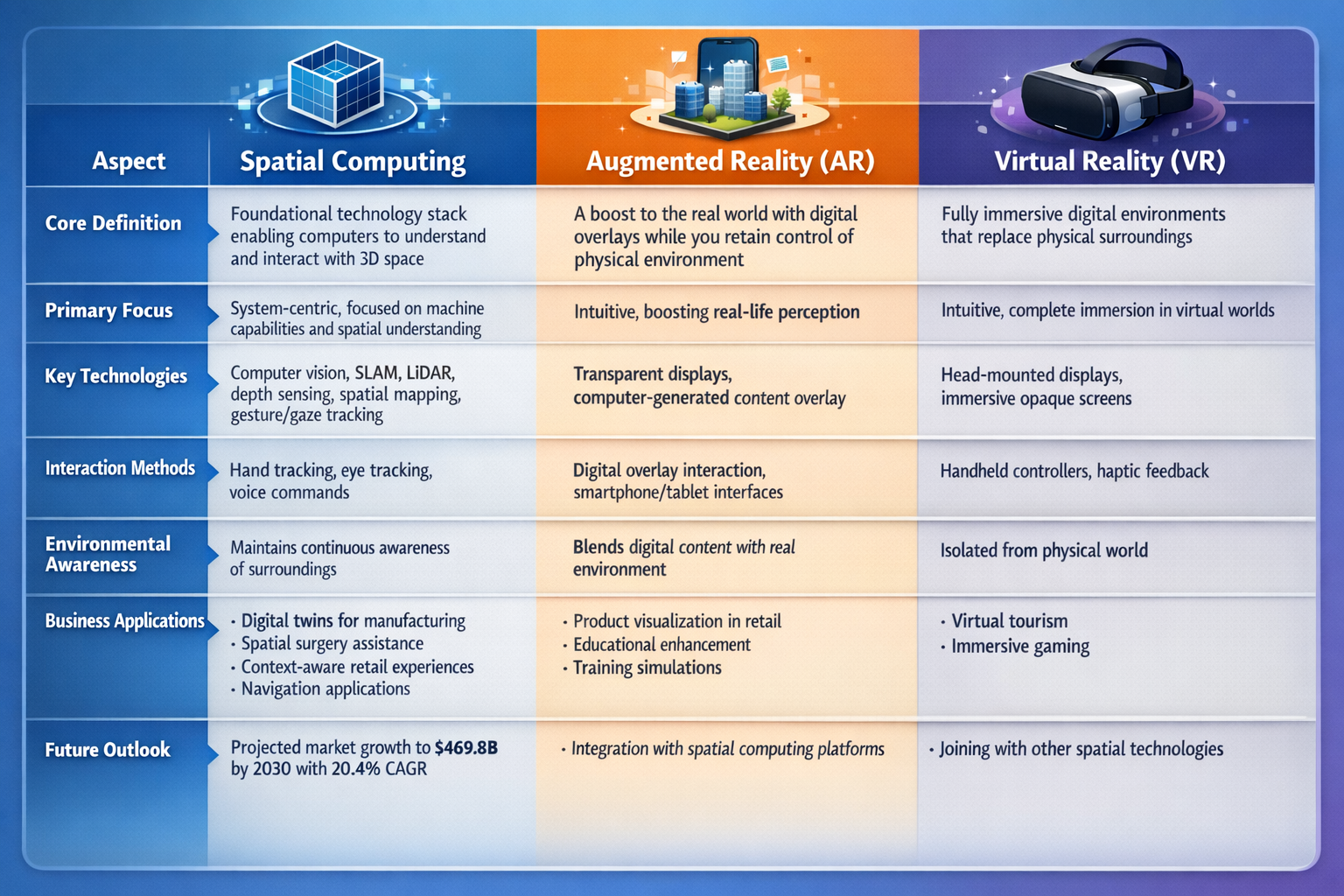
Spatial computing stands out from traditional VR and AR with its all-encompassing approach to blending digital and physical worlds in today's evolving tech landscape. This piece explores how spatial computing creates the foundation that powers many immersive experiences. AR adds digital overlays to reality while VR creates fully immersive environments.
These technologies offer way more than just novelty experiences in business applications. Retailers help customers visualize products before buying them. Surgeons can now access vital information during procedures. Manufacturers use digital twins to simulate production processes. Knowledge retention has improved through spatial visualization tools in educational institutions.
The future will see spatial computing, AR, and VR technologies meet as their boundaries become less distinct. Seamless transitions between immersive experiences will emerge, especially as AI and IoT technologies improve contextual awareness and responsiveness. Companies that adopt spatial technologies early will gain the most important competitive advantages through streamlined processes and better visualization capabilities.
The remarkable potential comes with challenges like cost barriers, infrastructure needs, and skill gaps. In spite of that, the market's expected growth to $469.8 billion by 2030 shows these technologies' power to change industries.
Spatial computing means more than just another tech advancement. It changes how we interact with digital information by breaking free from flat screens. Organizations that understand these differences and implement these technologies strategically will succeed in this new era where digital and physical realities blend together more closely.
Spatial Computing Industries
https://www.capgemini.com/be-en/insights/expert-perspectives/a-digital-revolution-how-spatial-computing-digital-twins-and-ai-are-transforming-industries/
Immersive Systems Review
https://pmc.ncbi.nlm.nih.gov/articles/PMC11231037/
VR AR Frameworks
https://www.sciencedirect.com/science/article/pii/S2666557321000367
Mixed Reality Study
https://www.sciencedirect.com/science/article/pii/S1931720425000856
Spatial Interaction Models
https://www.sciencedirect.com/science/article/pii/S2667344423000099
Digital Twin Concepts
https://www.ibm.com/think/topics/digital-twin
MR Gaming Trends
https://www.qodequay.com/mr-gaming-2025-immersive-digital-worlds
Beyond Screens
https://www.techmahindra.com/insights/views/beyond-screen-transformative-power-spatial-computing/
Future Tech Trends
https://www.forbes.com/sites/robertwolcott/2025/11/25/2026-trends-to-watch-physical-ai-spatial-computing-and-the-vr-boom/
Spatial Computing Research
https://www.ijirmps.org/papers/2024/4/231875.pdf
Spatial Computing Revolution
https://www.forbes.com/councils/forbestechcouncil/2023/07/31/the-spatial-computing-revolution/
Business Innovation Future
https://www.deloitte.com/ce/en/services/consulting/perspectives/spatial-computing-the-future-of-business-innovation.html
Mixed Reality Outlook
https://www.weforum.org/stories/2024/06/spatial-computing-mixed-reality/

By signing up, you are agreeing to Terms of service and Privacy policy.
You can withdraw consent at any time.
.svg)
.svg)
.svg)

.png)
