

.svg)
The traditional retail experience is undergoing its most significant transformation since the invention of the barcode. For decades, shopping involved a constant, distracting juggle: holding a heavy basket in one hand while digging a smartphone out of a pocket with the other to compare prices or check reviews.
This "disconnected" way of shopping is finally being replaced by Shopping 3.0.In 2026, the integration of ambient computing and smart glasses for shopping is creating a frictionless, hands-free bridge between the physical aisle and the digital marketplace. By leveraging AI-powered wearables, consumers are reclaiming their focus, shopping smarter, and turning every store visit into a data-driven experience.
The primary frustration of modern retail is "information asymmetry." You see a product on the shelf, but you are often blind to its true value and background. In the past, solving this required a disruptive ritual: stopping in the middle of a busy aisle, juggling a shopping basket, and scrolling through endless search results on a handheld screen—a major contributor to digital fatigue.
Wearable retail tech changes this dynamic entirely by making information "ambient" rather than "active." Imagine walking into a supermarket where your hands-free grocery list is managed by an AI that knows your pantry better than you do. As you approach a shelf, your glasses - equipped with advanced Computer Vision (CV)—recognize products instantly by their silhouette, logo, or barcode.
This isn't just about reading a label; it’s about contextual intelligence. If you pick up a bottle of wine, your glasses can instantly whisper pairing suggestions based on the steak you just put in your cart. You no longer need to manually "search" for data; instead, the data finds you. This shift from "pulling" information to having it "pushed" contextually allows you to remain present in the physical world while enjoying the full power of the digital one.
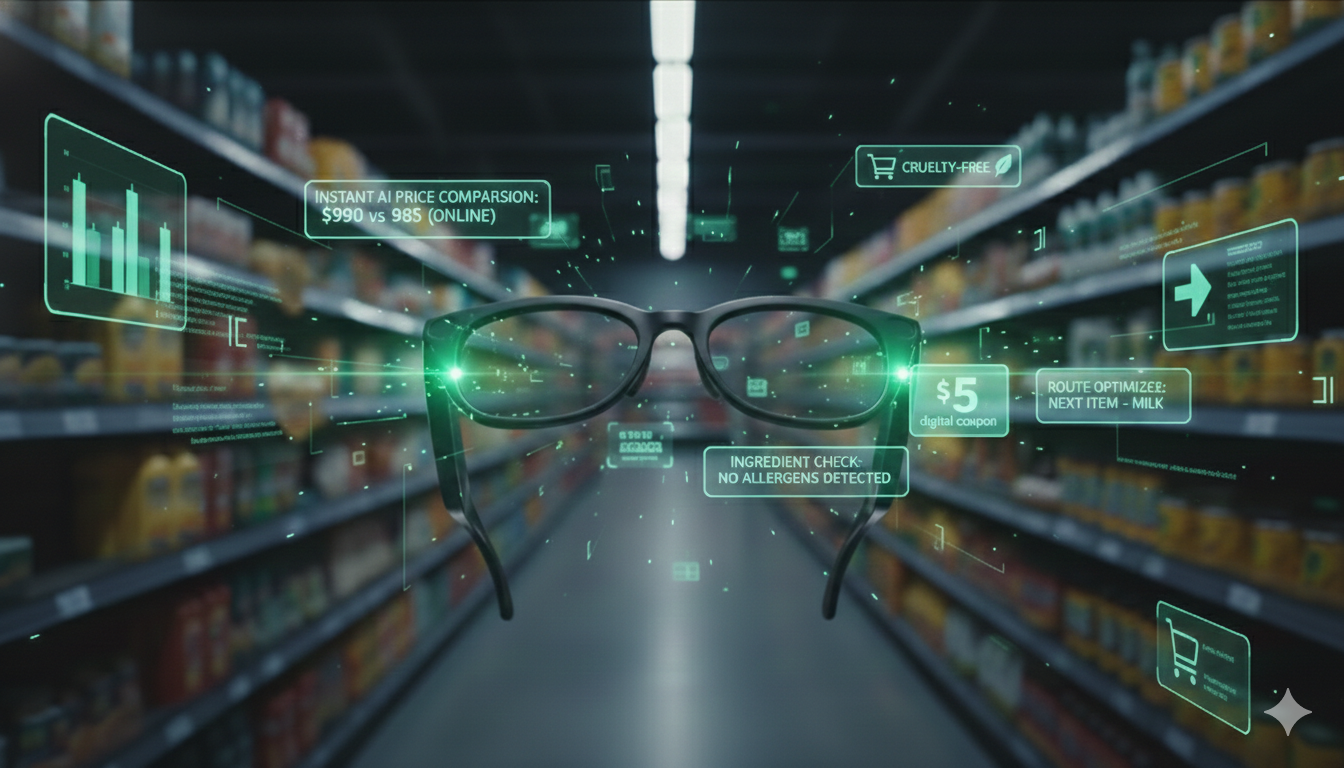
One of the most disruptive features of AI smart glasses in 2026 is real-time price transparency that functions at the speed of thought. While standing in front of a high-end electronics display or a designer clothing rack, you can simply whisper to your glasses, "Is this cheaper online?"
Through a lightning-fast API call to global marketplaces, your AI assistant provides an AI price comparison instantly via open-ear audio. It doesn’t just show you a raw number; it performs a complex multi-factor analysis. It checks shipping times, loyalty points, and local store availability. The AI might say, "This item is $20 cheaper at a store three blocks away, and I’ve found a $5 digital coupon for your current location."
By removing the "convenience tax"—the extra price we pay because we are too tired to research—smart glasses ensure you are always the smartest person in the room.
For shoppers with specific needs—be it veganism, gluten-free diets, or sustainability concerns—the retail aisle is a minefield of tiny, unreadable ingredient labels. Multimodal AI transforms this frustrating process into a natural conversation.
The Ethical Filter: Modern consumers are increasingly values-driven. You can now ask your glasses, "Is this brand cruelty-free?" or "Does this contain unsustainable palm oil?" Your glasses scan the packaging, cross-reference brand ownership databases, and provide an instant verdict. This enables conscious consumerism on the fly.
Dietary Safety & Precision Health: For those managing severe allergies or specific health goals, wearable monitoring devices act as a second set of eyes. Your glasses can cross-reference an ingredient list against your biometric profile, whispering a proactive warning if a hidden allergen is detected. It can even track your "Cart Macros," telling you, "You've reached your sugar limit for the week with this purchase."
Large-format retail stores and multi-story malls can be navigational nightmares. In 2026, indoor positioning systems (IPS) integrated with AI glasses are finally solving the "needle in a haystack" problem.
Your glasses can guide you through a store using spatial audio cues, leading you directly to the items on your list in the most efficient path possible. If you need a specific type of lightbulb, the AI doesn't just tell you "Aisle 4"; it provides directional audio that gets louder or "beeps" as you face the correct shelf.
This micro-navigation helps eliminate decision fatigue—the mental exhaustion that comes from being overwhelmed by choices and directions.
For decades, retail layouts have been designed to trigger impulsive behavior—placing high-margin items at eye level and essentials like milk at the back. However, AI shopping assistants are flipping this script. When your glasses provide a direct, optimized path to the items on your list, you are less likely to fall for "end-cap" traps.
The AI acts as a rational filter, protecting your budget by focusing on intent-based shopping. This forces brands to compete on actual product quality and transparency rather than psychological manipulation.
"Showrooming"—inspecting a product in a physical store only to buy it cheaper online—used to feel clandestine. In 2026, wearable retail tech has normalized this, turning every brick-and-mortar store into a living catalog.
Retailers are responding by offering "Instant Match" discounts; as your glasses detect a lower online price, the store’s local network can push a one-time digital coupon to your device.
This creates a hyper-competitive, real-time bidding war for your attention, putting the bargaining power back in the hands of the consumer.
The "dreaded queue" is the final friction point, but AI glasses are facilitate a transition toward a truly autonomous retail experience.
By using high-precision sensors to track which items you’ve placed in your physical cart, your glasses can maintain a "Digital Twin" of your basket in real-time.
When you're finished, there’s no need to unload items onto a conveyor belt. A simple voice confirmation or a biometric nod allows you to bypass the register entirely, with the transaction occurring securely in the background.
In markets like India, where the AI hardware revolution is booming, smart glasses support local businesses. AI assistants can prioritize "Made in India" products or highlight items from small-scale artisans that might otherwise be overshadowed.
Imagine walking through a market and having your glasses highlight a handmade craft, providing the story of the artisan via audio. This adds a layer of emotional and cultural storytelling to the shopping experience, proving that Shopping 3.0 is as much about connection as it is about data.
Shopping 3.0 represents a pivotal shift from being a passive consumer to an empowered, data-driven shopper. By moving digital interaction from the palm of your hand to your field of vision, AI-powered smart glasses do more than just compare prices; they restore the "human" element to retail. We are entering an era where we can finally stop staring at glass screens and start looking at the products, people, and world around us - all while having the most sophisticated research tool in history sitting right on our noses.
As we move toward a "post-smartphone" future, the most successful technologies will be those that prioritize situational awareness and digital wellbeing.
Smart glasses aren't here to add more digital noise to our lives; they are here to filter it, ensuring that our shopping habits are as efficient, ethical, and informed as possible. The future of retail isn't just about what we buy - it’s about how clearly we see the world while we’re buying it.
IDC (2026): The Future of Smart Glasses: CES 2026 Innovation Report. (Covers the shift of smart glasses from niche gaming to mainstream retail and productivity tools).
Digital Sense (2026): AI in eCommerce in 2026: Trends, Use Cases & Full Expert Guide. (Discusses "Agentic Commerce" and AI acting as an active shopping partner).
Gopazo (2025): The Future of Retail Shopping: What's Next for 2026? (Highlights the rise of voice-activated browsing and hands-free price comparisons).
MarketsandMarkets (2026): Smart Glasses Market Size, Share & Growth Report 2030. (Examines the role of 5G and AI in accelerating retail wearable adoption).
Cervicorn Consulting (2025): AI Smart Glasses Market Analysis: Retail & E-commerce Trends. (Details how AI glasses are being used for product visualization and experiential shopping).
About Amazon (2025): Amazon’s Smart Glasses for Hands-Free Navigation and Asset Scanning. (While focused on delivery, it showcases the Computer Vision tech used to identify products/packages).
The Business Research Company (2026): AI Shopping Assistant Market Report 2026. (Forecasts the growth of AI-driven shopping support and virtual try-ons).
Frontiers in Virtual Reality (2022/2025 Update): Consumer Behavior in Augmented Shopping Reality. (A foundational research synthesis on how AR/AI influences the retail decision process).
Robeco (2026): Consumer Trends in 2026: The Wearables Comeback. (Analyzes how AI-powered wearables are becoming a primary interface for value-conscious consumers).
BrandXR (2025): Best AI Glasses of 2025: Market Inflection and Consumer Adoption. (Reports on the tripling of AI wearable sales and their integration into the retail ecosystem).

By signing up, you are agreeing to Terms of service and Privacy policy.
You can withdraw consent at any time.
.svg)
.svg)
.svg)

.png)
