

.svg)
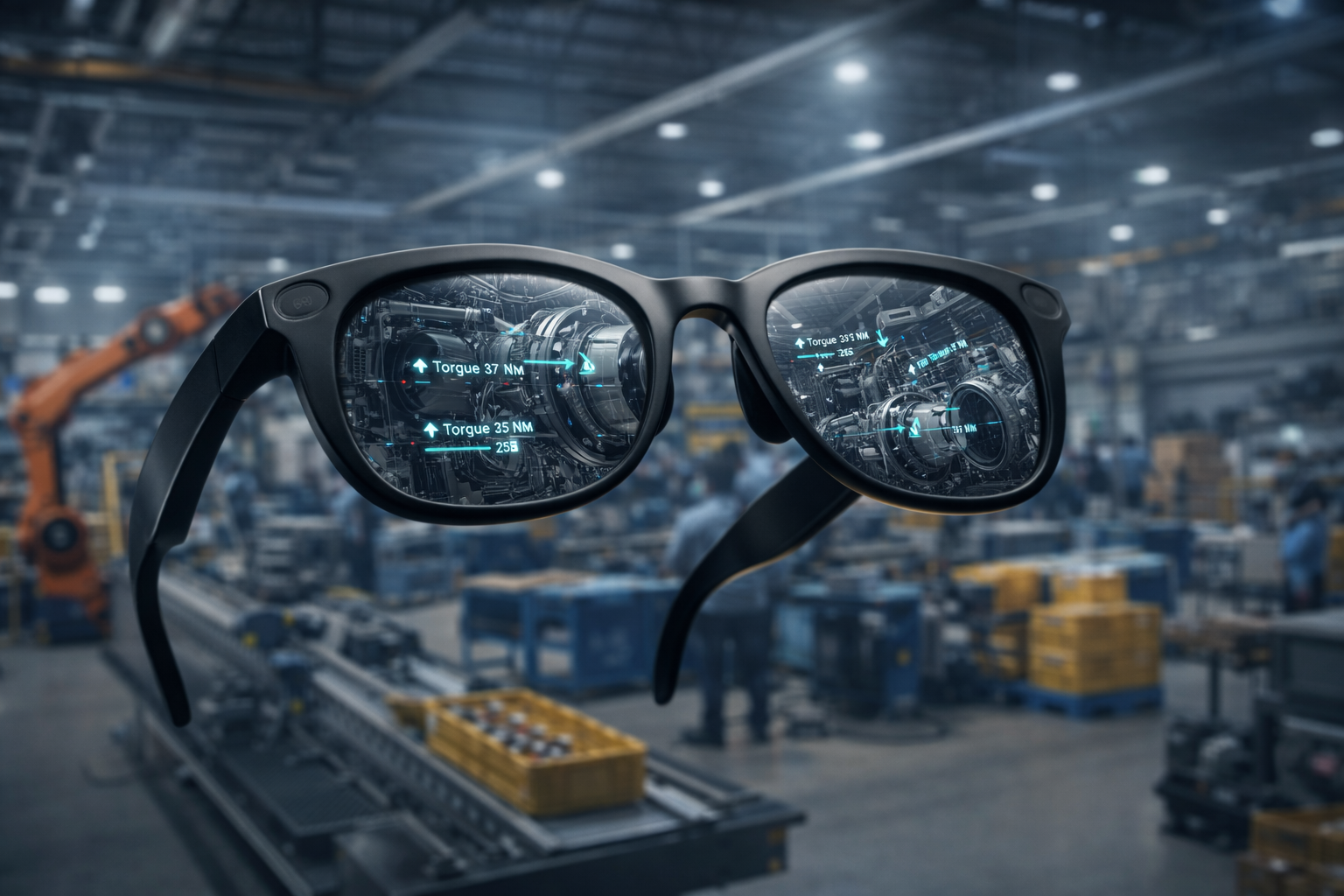
Smart glasses are changing how Indian workers learn complex manufacturing tasks. The global market for industrial smart glasses shows promising growth. From USD 658.4 million in 2025, it will reach USD 3,052.6 million by 2032 with a compound annual growth rate of 24.5%. This growth reflects a radical alteration in training methods used at production facilities.
These wearable devices connect human workers to the modern manufacturing environment's interconnected systems. Workers can keep their hands free while accessing live information, which leads to better accuracy and faster decisions during critical operations. Smart glasses help workers learn at their own speed without constant supervisor oversight. Let's explore how Indian factories use industrial smart safety glasses, what they cost, and how they affect workforce development and operational efficiency.
Smart glasses for industrial use have evolved by a lot to meet manufacturing needs. These specialized devices blend advanced optics, connectivity, and tough design to show important information right in front of workers' eyes.
Today's industrial smart glasses use waveguide projection technology to show digital content on transparent lenses. Text, images, and 3D models appear to float in the physical world. Workers don't need to check paper manuals or screens anymore, which reduces errors during complex tasks.
The displays are bright enough (over 2000 nits) to work in any lighting condition, including direct sunlight. This is vital for Indian factories that operate both indoors and outdoors. The glasses also come with smart microphone systems that can pick up voice commands even in noisy factory settings.
Workers can control these glasses with simple voice commands, which helps them stay efficient when they're wearing thick gloves or using tools. This hands-free feature is a great way to get work done during assembly, quality checks, and maintenance tasks that need both hands.
Wi-Fi connectivity leads the industrial smart glasses market with a 51.2% share expected in 2025. It provides reliable, high-speed coverage throughout large manufacturing facilities. The reliable connection keeps workers' glasses linked to central systems, and production runs smoothly even with large equipment and changing wireless signals nearby.
Bluetooth 5.0 works alongside Wi-Fi to pair with smartphones and other devices while saving battery power. 5G and edge computing help process live data, so critical information reaches workers instantly, even in remote areas where connectivity is limited.
Smart glasses used in Indian industries need to handle tough conditions. Military-grade certifications (like MIL-STD-810H) show these devices can handle extreme pressure, temperature changes, and harsh chemicals.
Key features include:
- Working temperatures from -20°C to 45°C (-4°F to 113°F), perfect for Indian industrial settings
- Impact-resistant build for tough conditions
- IPX4 water resistance protects against splashes, sweat, and light rain
Battery life is key to keeping work flowing. Power-efficient designs let workers use the glasses throughout their shifts, and some models let you swap batteries without turning off the device. The glasses typically run for 4-6 hours with AR features on and can stay in standby mode all day.
The charging cases can power up batteries to 50% in about 20 minutes, which keeps the glasses ready for continuous use. This mix of reliable connectivity, user-friendly controls, and tough design makes these glasses valuable tools for industrial training in manufacturing facilities of all sizes across India.
Indian manufacturers now use smart glasses to train their workforce through immersive learning experiences. These devices have become extremely useful tools to train workers in various factory scenarios.
Workers on assembly lines use smart glasses that display step-by-step visual instructions right in front of their eyes. This hands-free method lets trainees learn complex procedures without checking manuals or asking supervisors. The worker's field of view shows digital information that helps apply knowledge immediately. This technology connects classroom learning with practical skills, as trainees see animated arrows pointing to components and torque values next to fastening points.
Smart glasses connect new workers with remote experts quickly and cut travel costs [link_1] while helping workers learn faster. Workers can start video calls when they face problems with equipment, letting experts see everything from their perspective. The specialists can draw helpful notes directly in the trainee's view to guide them through complex tasks. These recorded sessions become valuable training materials that help Indian manufacturers build a complete knowledge base.
Pick-by-Vision technology has changed how Indian facilities train warehouse workers. Smart glasses show trainees the following picking instructions through a small display:
- Exact storage locations and item quantities
- Barcode scanning confirmation prompts
- Navigation guidance through warehouse zones
This method cuts training time because workers make fewer mistakes compared to old training methods.
Smart glasses have revolutionized safety training by creating virtual hazardous scenarios in safe environments. Workers can practice handling chemical spills, electrical problems, or machine failures without actual risks. The glasses guide workers through critical procedures like lockout-tagout, showing exact steps to isolate energy sources and giving instant feedback on mistakes. This creates a safe space to practice emergency responses and prevents accidents.
Smart glasses deployment for industrial training in India needs careful analysis of various cost factors that go beyond the basic hardware costs.
Smart glasses prices in India change based on their functionality level. Entry-level notification glasses start from ₹8,000, and go up to ₹25,000. AR-enabled models in the mid-range typically cost between ₹65,000 and ₹2,00,000. Industrial-grade versions cost between ₹3,00,000 to ₹8,00,000 per unit. These prices factor in import duties (around 20%) and GST (18%).
Companies save money through faster and better training outcomes. Aircraft manufacturers who use smart glasses for assembly training achieve 90% task completion accuracy compared to 50% with traditional methods. They also cut training time by 35%. Automotive companies speed up technical upskilling by 40%. Companies reduce their employee onboarding time by 40-60%.
Small and medium enterprises worry about ongoing costs. Some providers give free software updates, but businesses need to pay for system integration and strong infrastructure like high-speed internet. The total ownership cost combines the upfront capital spending and regular operational expenses.
ROI depends on how widely companies implement smart glasses and their specific use cases. Manufacturing units often cut their training period by half. They save more through reduced material waste and less production downtime. A complete ROI calculation should factor in direct savings from fewer errors and lower travel costs, along with indirect benefits like better employee retention.
Smart glasses bring clear benefits to industrial training in India by improving workforce capabilities. These devices revolutionize skill development with budget-friendly solutions that deliver measurable results.
Smart glasses have shown remarkable results in training environments. DHL's implementation of AR in warehouse operations led to error rates falling below 0.1%. Assembly training accuracy jumped to 90% with smart glasses compared to 50% with traditional methods. Workers make fewer mistakes because instructions stay in their line of sight, which eliminates guesswork and memory dependence.
Smart glasses have cut technical training time significantly. Studies show a 25% shorter training duration. New employees now reach full productivity in half the time, cutting onboarding periods by 40-60%. Research proves that new hires match their experienced colleagues' productivity levels much faster, which lets them work on their own sooner.
Smart glasses turn skill development into a tailored learning journey. Employees can practice complex tasks without real-life risks, while still getting authentic training value. Airbus cut learning time by 30% with their AR aircraft assembly training program. Ford's engineers now work together virtually through AR in their product development training.
Immediate analytics and monitoring provide quick guidance to trainees. Smart glasses monitor performance and correct mistakes as they happen. This technology guides and tracks operators' performance and spots areas where workers need extra help. Data gathered helps create better training programs, which leads to continuous improvement.
Smart glasses have revolutionized industrial training in India's manufacturing world. The market shows promising growth with a CAGR of 24.5% through 2032, as more companies adopt this technology. These wearable devices excel through their AR displays, uninterrupted connectivity, and rugged design built for tough industrial environments.
Real-world applications prove why these devices work so well in Indian manufacturing. AR overlays on assembly lines help workers learn complex tasks without constant supervision. Workers can connect with experts remotely, which cuts travel costs and speeds up training. Pick-by-vision technology in warehouse training reduces errors and shortens learning curves. Workers practice emergency responses safely through simulations that prepare them for real situations.
Cost plays a crucial role in adoption decisions. Hardware prices range from ₹8,000 for simple models to ₹8,00,000 for industrial versions, but the return on investment is clear. Companies report 40-60% faster onboarding and 90% task accuracy—far better than traditional methods.
The impact on workforce efficiency tells a compelling story. Warehouse operations see error rates drop below 0.1%, while technical training time shrinks by 25%. Workers reach peak productivity twice as fast, which enables quick deployment across facilities. Teams can upgrade their skills through AR modules without stopping production, and tracking systems spot areas that need more focus.
As Indian manufacturing moves toward Industry 4.0, smart glasses serve as vital tools that connect technology with human capability. These devices bring knowledge right to workers' eyes, which changes how industrial training happens. Companies that embrace this innovation gain an edge through faster learning, fewer mistakes, and a workforce ready for tomorrow's manufacturing challenges.
Coherent Market Insights
Smart Glasses for Industrial Applications Market – Global Analysis
https://www.coherentmarketinsights.com/industry-reports/smart-glasses-for-industrial-applications-market
ResearchGate (Peer-Reviewed Paper)
Applying Augmented Reality on Smart Glasses to Minimize Human Error in Hands-Free Technical Training
https://www.researchgate.net/publication/347521307_APPLYING_AUGMENTED_REALITY_ON_SMART_GLASSES_TO_MINIMIZE_HUMAN_ERROR_IN_HANDS-FREE_TECHNICAL_TRAINING
IOS Press (Academic / Conference Proceedings)
Augmented & Virtual Reality in Industrial Training
https://ebooks.iospress.nl/pdf/doi/10.3233/ATDE230902
Supply Chain Management Review (SCMR)
Augmented Reality’s Role in Upskilling the Workforce
https://www.scmr.com/article/augmented-realitys-role-in-upskilling-the-workforce
ManufactureNow (Industrial Media)
Augmented Reality in Manufacturing Training
https://www.manufacturenow.in/blogs/augmented-reality-manufacturing-training
Manufacturing Tomorrow
The Real ROI of AR in Manufacturing: Beyond the Hype
https://www.manufacturingtomorrow.com/story/2025/09/the-real-roi-of-ar-in-manufacturing-beyond-the-hype/25857/
Mecalux (Intralogistics Knowledge Base)
Pick-by-Vision: How Smart Glasses Improve Warehouse Productivity
https://www.mecalux.com/blog/pick-by-vision
IGZ – Institute for Business Logistics (Germany)
Pick-by-Vision with SAP EWM and Smart Glasses
https://www.igz.com/en/newsroom/news/pick-by-vision-with-sap-ewm-and-smart-glasses/
ManageXR (Enterprise XR Platform – Neutral Content)
How Augmented Reality Is Used in Manufacturing
https://www.managexr.com/blog/how-augmented-reality-is-used-in-manufacturing
TeamViewer – Enterprise Insights
How AR Smart Glasses Increase Employee Satisfaction
https://www.teamviewer.com/en-in/insights/5-tips-on-how-ar-smart-glasses-increase-employee-satisfaction/
Financial Express (India – Business Media)
Smart Vision Glasses Supporting Indian Languages & Affordability
https://www.financialexpress.com/business/healthcare-unlike-market-competitor-our-smart-vision-glasses-support-indian-languages-has-walking-assistance-and-it-is-affordable-ramu-muthangi-ceo-and-co-founder-shg-technologies-3039675/
Think AI Corp
AR/XR-Enabled Digital Workplaces
https://thinkaicorp.com/ar-xr-enabled-digital-workplaces-building-a-smarter-faster-workforce/

By signing up, you are agreeing to Terms of service and Privacy policy.
You can withdraw consent at any time.
.svg)
.svg)
.svg)

.png)
