

.svg)
- Next-Gen Intelligence: Devices like smart rings and AI eyewear move beyond fitness tracking to provide "ambient intelligence" and automated meeting support.
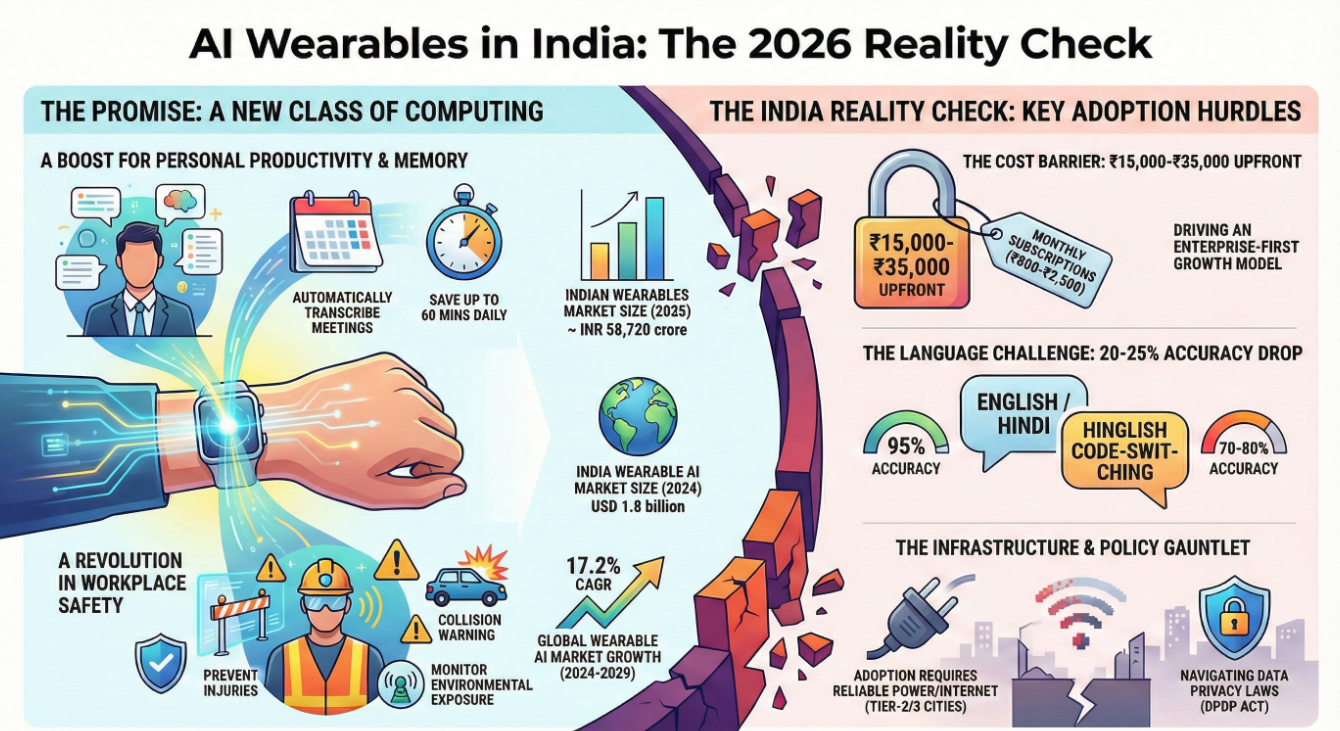
- The India Gap: Language "code-switching" (Hinglish) reduces AI accuracy from 95% to 70-80%, posing a hurdle for local professionals.
-Market Growth: India’s wearable AI market has reached $1.8 billion, driven by enterprise use cases in logistics and consulting.
- Strategic Adoption: Leaders should prioritize local data residency (DPDP Act compliance) and choose devices that augment, rather than replace, smartphones.
- Cost Factor: Typical hardware costs range from ₹15,000–₹35,000, often requiring corporate subsidies for wide-scale rollout.
AI wearables are revolutionizing business operations in a market worth tens of billions of dollars in the early 2020s. These sophisticated devices are growing rapidly, giving Indian business leaders a great chance to welcome the next wave of digital transformation.
These wearable devices with AI capabilities do much more than track fitness. They utilize multimodal AI technology to analyze biometric data streams. The devices track heart rate variability, sleep patterns, and blood oxygen levels to give detailed health insights. The global multimodal AI market will reach $10.89 billion by 2030. This shows why business leaders need to learn about what these personal AI devices can do. The practical side for Indian professionals shows most AI wearables cost between ₹15,000-₹35,000. Monthly subscriptions range from ₹800-₹2,500.
This piece explains what smart wearables with multimodal capabilities really are. You'll learn why they matter for Indian businesses and what unique challenges they face in our market. We'll help you review these smartphone alternatives in India for your organization. On top of that, we'll tackle a key limitation: AI wearables don't deal very well with code-switching. Their accuracy drops from 95% in pure English to just 70-80% in realistic Indian conversations.
Multimodal AI wearables will revolutionize the wearable technology landscape by 2026. These devices go beyond traditional fitness trackers or smartwatches. They analyze multiple data streams through advanced AI algorithms that adapt and evolve over time.
AI-powered wearables convert raw data into meaningful insights, unlike traditional wearables that just collect and display information. A standard fitness tracker counts steps, but a multimodal AI wearable detects fatigue or health issues by analyzing walking patterns. These devices learn from user interactions and become more accurate over time.
The biggest difference shows in their intelligence. 70% of wearables in India now come with embedded AI that creates tailored recommendations and smarter experiences. They process data on-device or through secure cloud connections to give applicable information based on individual needs.
The wearable AI ecosystem has grown by a lot, offering devices of all types:
- Smart rings: These powerful yet discreet devices monitor physical health and emotional states with high precision from their strategic finger placement
- AI-enabled eyewear: These provide up-to-the-minute information through augmented reality displays
- Intelligent audio devices: Headphones and earbuds that adapt to context and enable cross-language communication
- Smart clothing: Garments with built-in sensors track health, posture, and activity levels
- Biometric wearables: Clinical-grade devices offer ECG support, glucose monitoring, and anomaly detection
These devices use reliable encryption protocols and strong privacy controls to protect sensitive health data, addressing users' main concerns.
India's wearable market shows remarkable growth with devices like the Acer FreeSense Ring becoming popular. This 23-gram titanium alloy ring tracks heart rate, heart rate variability, blood oxygen, and sleep quality. It converts these readings into AI-driven wellness insights.
The Ayushman Bharat Digital Mission's integration with wearables has strengthened India's e-health ecosystem. Rural patients can share their health data with specialists in real time through integrated telemedicine solutions. Pilot studies show this has reduced diagnostic delays by up to 30%.
Haptic smartwatches designed for visually impaired users have advanced inclusivity in wearable technology. These watches offer tactile alerts, health tracking, and privacy-friendly notifications through customized vibration patterns.
Multimodal AI wearables have become essential business tools rather than optional gadgets in 2026. The global wearable AI market, valued at USD 62.7 billion in 2024, will reach USD 138.5 billion by 2029-growing at a remarkable CAGR of 17.2%. India's market has already hit USD 1.8 billion. These numbers show why Indian business leaders should act now.
Ambient intelligence has started replacing traditional app-centric workflows—technology that senses, analyzes, and responds on its own without explicit commands. This progress creates what engineers call a digital "sixth sense" that lets environments adapt instantly. So, business spaces become more user-friendly and efficient.
India's ambient intelligence market reached INR 1990.53 billion in 2023 and will grow to INR 14540.44 billion by 2032, with a 24.8% annual growth rate. This change brings automation of routine tasks, resource optimization, and improved security without manual input—your organization gets a head start.
The productivity advantage makes the strongest case for adoption. The real reason isn't technical but human: most professionals can't remember their last three meetings without checking notes.
Wearable AI devices solve this problem through features like:
- Automatic meeting transcription and action item extraction
- Personal memory search across weeks of conversations
- Commitment tracking that flags approaching deadlines
A Bangalore IT firm tested AI pendants with 50 client-facing consultants and justified costs through less post-meeting administration time. The University of Michigan received INR 16.8 million to develop NeuroTrace—a system that uses smart glasses to capture and retrieve key moments, from vital meetings to finding misplaced items.
Practical business applications speed up adoption across India. AI-enabled wearables now provide up-to-the-minute data analysis and predictive analytics that move safety management from reactive incident handling to proactive risk control. These devices excel at preventing musculoskeletal disorders—a constant cause of workplace absence and lower productivity.
Wearables in Indian warehouses give workers instant access to vital information and optimize workflows in the growing INR 6750.44 billion e-commerce market. As multimodal AI wearables progress from novelties to necessities, early adopters in Indian businesses will gain major competitive advantages.
Wearable AI devices show great promise in India, but unique challenges need our attention. These challenges shape how multimodal AI wearables work and deliver value in our context.
India's multilingual nature creates major hurdles for personal AI devices. AI systems don't deal very well with code-switching when users mix languages in conversations. The accuracy drops from 95% in pure English to 70-80% in typical Indian conversations.
A simple phrase like "Yaar, deadline ko stretch kar sakte hain kya because client ne requirements change kar diye" leaves many devices confused. Indian pronunciations often confuse AI systems trained on American English, which makes things even harder.
Multimodal AI wearables range between ₹15,000-₹35,000 with monthly subscriptions of ₹800-₹2,500. Students and early-career professionals find these prices too high. Companies drive the growth by providing these devices just like laptops. A Bangalore IT services firm has tested AI pendants with its consultants to cut down administrative time.
Wearable AI devices need stable internet for cloud processing and reliable power for daily charging. Urban India meets these needs, but tier-2 and tier-3 cities face big challenges. India processes nearly 20% of the world's data yet provides less than 3% of global compute capacity. This gap creates AI infrastructure bottlenecks.
Indian work culture has closer boundaries than Western societies - we share phones and make decisions together. Recording conversations with senior colleagues or family elders might seem disrespectful because of social hierarchy. Indians show more openness to automation than their Western counterparts, but trust levels drop when AI systems start making autonomous decisions. This gap between temporary recording and permanent, searchable data creates unique barriers to adoption.
Choosing the right multimodal AI wearable takes more than just looking at fancy features. You just need to evaluate wearable devices with AI capabilities carefully before investing your organization's resources.
Here's what you should get into when looking at personal AI devices:
- Privacy controls: Make sure you can delete recordings easily and check if the processing happens on the device or in cloud servers
- Integration capabilities: The device should connect to your calendars, emails, and note-taking systems
- Accuracy testing: Try it out with your accent, mixed languages, and the noise levels you'd find in Indian workplaces
- Company stability: Go with vendors who have solid business models so your device doesn't become obsolete
India's Digital Personal Data Protection Act creates a balance between data flow limits and state-of-the-art AI development. This framework puts extra requirements on certain data fiduciaries, and they might have to process sensitive data only in India. So, you should pick devices that process data locally or use India-based servers to follow data localization rules.
A wearable without connections to other systems won't do you much good. Before you buy, check if the device blends with your current tools. Organizations get better results when they put AI wearables into well-laid-out safety frameworks.
We found that devices that increase smartphone capabilities work better than those trying to replace them. Replacing smartphones completely faces big challenges in battery life, connectivity, and app ecosystems that are years old.
Multimodal AI wearables create both exciting chances and real challenges for Indian businesses. These sophisticated devices are nowhere near just another gadget trend. They give companies real competitive edges through ambient intelligence, boosted productivity, and uninterrupted access to information.
Business leaders need to think about adoption carefully. Language processing limitations create genuine problems, especially since accuracy drops by a lot during typical Indian conversations with mixed languages. The costs, need for strong infrastructure, and cultural acceptance don't deal very well with quick implementation plans.
Smart organizations can start small to see results. They might begin with targeted rollouts for customer-facing teams where ROI looks most promising. Companies can learn about actual benefits versus costs through pilot programs, like those run by IT firms in Bangalore, while they tackle integration challenges step by step.
These obstacles won't stop progress. The market's growing value and increasing enterprise use cases show that wearable AI marks a fundamental change rather than a passing trend. Indian businesses that create assessment frameworks now will be in a better position as the technology improves and solves current limitations.
The real question for Indian business leaders isn't about whether multimodal AI wearables will reshape the scene of workplace productivity. It's about the right time and method to begin adoption. Leaders who assess their options now and plan for future capabilities will be ready for the ambient intelligence that's coming.
Data localisation, privacy, and AI innovation in India
https://www.orfonline.org/expert-speak/india-at-crossroads-balancing-data-localisation-privacy-and-ai-innovation
AI wearables and productivity use cases in India (2026)
https://www.techaffiliate.in/blog/ai-wearables-india-2026-lifelogging-devices-productivity
Wearables as a core driver of India’s consumer and enterprise tech growth
https://www.exchange4media.com/marketing-news/consumer-tech-focusing-on-smartphones-wearables-in-india-146414.html
Market outlook for wearable AI and multimodal systems
https://www.marketsandmarkets.com/ResearchInsight/future-of-wearable-ai-industry.asp
India wearable AI market size, adoption, and enterprise segments
https://www.kenresearch.com/industry-reports/india-wearable-ai-market
Ambient computing and its impact on business operations
https://thinkaicorp.com/the-seamless-workplace-how-ambient-computing-is-transforming-business-operations/
Ambient intelligence as the next phase of applied AI
https://www.techaheadcorp.com/blog/ambient-intelligence-next-step-for-artificial-intelligence/
Wearable memory augmentation and human-AI co-working systems
https://cse-report.engin.umich.edu/2025/08/07/wearable-memory-augmentation-system/
AI-powered wearables in workplace health and safety
https://www.britsafe.in/safety-management-news/2025/ai-powered-wearables-transforming-workplace-health-and-safety
Wearables transforming logistics, warehousing, and industrial operations in India
https://www.etedge-insights.com/industry/logistics/wearables-revolutionizing-warehousing-a-glimpse-into-indias-tech-driven-future/
India’s need for sovereign AI infrastructure and compute ownershiphttps://www.expresscomputer.in/news/power-compute-and-sovereignty-why-india-must-build-its-own-ai-infrastructure-in-2026/131404/

By signing up, you are agreeing to Terms of service and Privacy policy.
You can withdraw consent at any time.
.svg)
.svg)
.svg)

.png)
