

.svg)
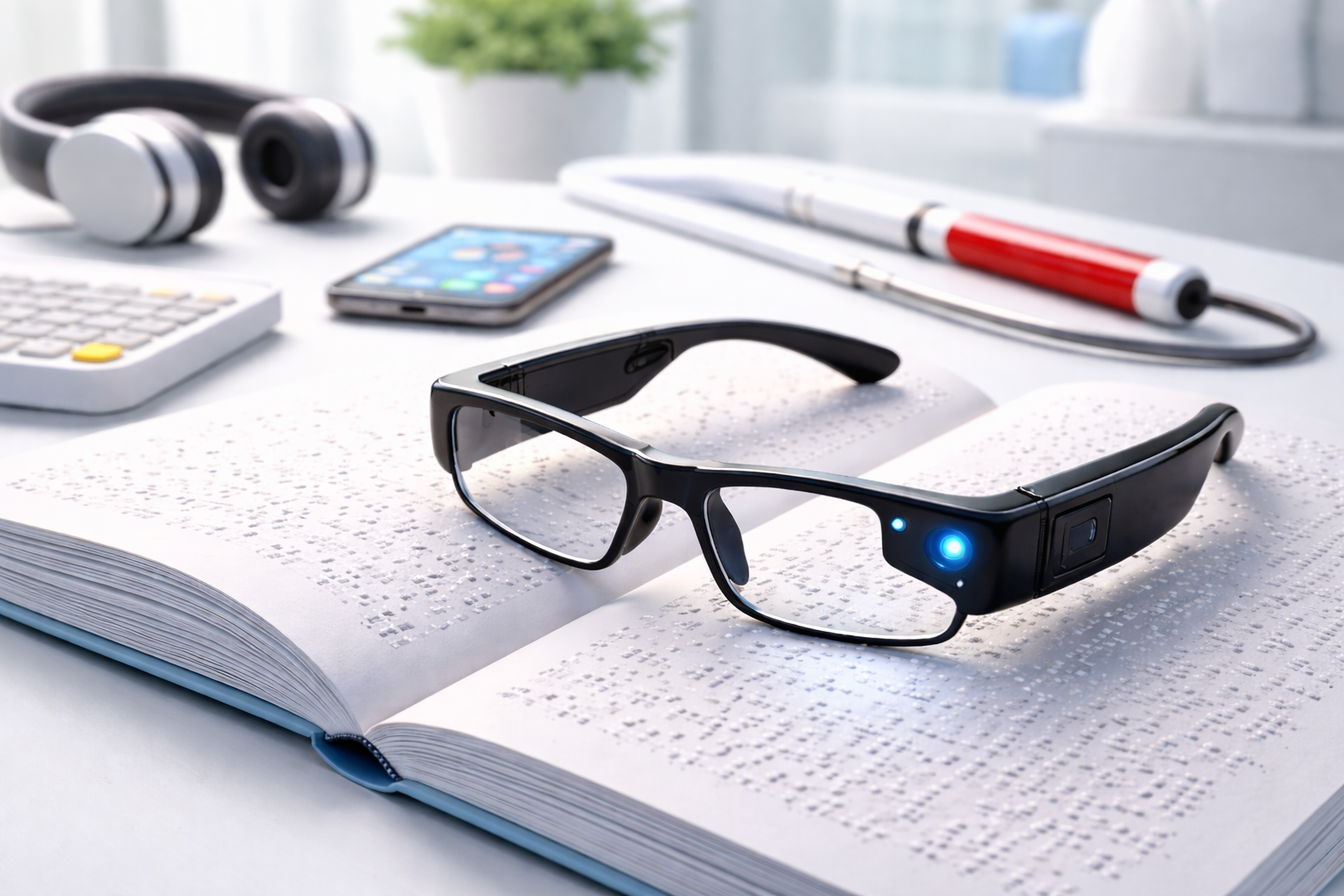
The numbers are staggering - 4.80 million people in India live with blindness, while 4.69 million face severe visual impairment. Smart glasses have changed daily life for these millions worldwide, including 26.9 million American adults who struggle to see even with corrective lenses.
Delhi's recent launch of Smart Vision Glasses (SVG) 2.0 represents the most important breakthrough in assistive technology. These AI-powered smart glasses give visually impaired users remarkable capabilities through object detection, facial recognition, reading assistance, Indian language support, and navigation. The price point stands at less than 10% of Western alternatives, making this technology available to more people than ever before.
The effectiveness of these smart glasses has been proven conclusively. A study of 90 participants from five vision rehabilitation centers across India revealed impressive results. Users praised multiple functions - 72.9% found value in reading features, 44.7% benefited from object detection, 36.5% appreciated facial recognition, and 22.4% relied on walking assistance. Every participant successfully used all SVG functions.
This piece will show how these innovative devices change lives by exploring their core functions, design elements, user experiences, and initiatives that help visually impaired people gain independence.
Smart glasses help visually impaired users with AI-powered features that provide real-time help. These devices work like electronic eyes and turn visual information into audio feedback. Users can guide themselves through their surroundings with confidence and independence.
Advanced object detection technology in modern smart vision glasses spots everyday items, potential risks, and navigation elements around the user. The glasses use convolutional neural networks and deep learning algorithms to detect obstacles up to 1 meter away and give instant audio alerts. The system spots vehicles, traffic signals, zebra crossings, furniture, and other objects. Users can move safely without help.
Field trials showed these smart glasses achieved 100% collision avoidance in real-life urban settings. The tests included complex indoor spaces like shopping centers and tough outdoor conditions such as snowy city streets. The multi-sensory alert system combines sound and touch responses. Vibration frequencies change based on how close objects are—200Hz for objects within 3 meters and 150Hz for those beyond.
Smart glasses' text recognition and reading abilities make them valuable for blind people. The glasses use Optical Character Recognition (OCR) technology to read printed books, road signs, and handwritten manuscripts. Users can pause to understand the text, continue reading, and control the flow as needed.
Smart vision glasses support many languages including English, Hindi, and regional Indian languages like Tamil, Telugu, Malayalam, Kannada, Marathi, and Gujarati. This language support makes these devices valuable in diverse linguistic settings.
Assistive smart glasses' facial recognition features help visually impaired people identify others around them. The system recognizes people, estimates their age, spots expressions, and identifies known individuals whose names were previously saved. Advanced models reach 95% accuracy in facial recognition, which substantially improves users' social interactions.
AI-powered smart glasses include GPS navigation to direct users through unfamiliar areas. Audio-guided navigation helps users traverse different environments, from indoor spaces to public transport and city streets. Voice instructions tell users about nearby landmarks and potential obstacles as they approach their destination. To name just one example, the glasses might say: "Walk straight for 100 meters, turn left, and cross the street at the pedestrian crossing."
These core functions create a detailed support system that boosts mobility, independence, and quality of life for visually impaired people.
Smart glasses for visually impaired people combine sophisticated engineering with thoughtful design. These lightweight devices blend hardware precision and software intelligence to create technology that's available to assist users.
Smart vision glasses use a camera mounted on standard spectacle frames that lets users "see" through technology. Most models come with a spectacle-mounted camera with flash and Lidar technology to boost depth perception.
Users can find braille-coded keys placed at easy-to-reach spots on the frame. These tactile buttons each do something specific: T identifies things nearby, R reads text, W helps with walking, F recognizes faces, and S puts the device on standby. Blind users can use their devices on their own just by touch.
Voice commands let users interact with their smart vision glasses. The device's voice recognition system picks up specific phrases to activate different features. Users just need to say things like "look and read this" to hear text read out loud or "look and tell me what you see" to learn about their surroundings. The latest models understand natural questions about objects, like "do you see a set of keys?" and "where are they?".
Your smartphone works as the computational "brain" while the glasses act as sensors. This setup keeps the glasses light by letting the phone handle the heavy processing. The phone's companion app works as a control center to manage notifications, set up gesture controls, and adjust voice assistant settings. These devices work with Android 10 and newer versions, so they're compatible with many smartphones.
Different smart glasses models have varying battery performance. You can use them for 6-16 hours based on which features you use. The battery drains faster with video recording or streaming, lasting about 30-60 minutes. Many models come with charging cases that add extra power cycles away from outlets - making them last for days instead of hours. The battery stays healthy when you use official cables and adapters and keep it away from extreme temperatures.
Smart glasses have transformed daily life for visually impaired people, as shown by extensive user feedback. These devices help users live more independently and are becoming essential tools in their daily activities.
Smart vision glasses have received overwhelmingly positive responses from users. A detailed study shows that all users adapted well to the device, and 91% exceeded their original expectations for usage. The comfort level was high, with 94% of verbal communicators rating the glasses comfortable to wear. These results prove that assistive smart glasses deliver practical benefits beyond theoretical advantages.
Users typically start wearing their smart glasses right after their morning coffee. The devices help them gather information, find their way around, and read throughout the day. The battery lasts about 6 hours on a single charge, which makes them suitable for full-day use. After two months of regular use, many wearers report less stress and easier daily routines.
Smart vision glasses now work with Telugu and Kannada along with English and Hindi. This makes the experience more natural for regional language speakers. Users can speak to the AI in their preferred language to take photos, answer calls, and control media. The language features can be set up through Device Settings > Meta AI > Language and Voice in the companion app.
These smart glasses work remarkably well for people of all ages. The data shows that 91% of users across age groups can use all device functions. Voice commands make these devices particularly effective, as speaking is the most natural way for users to interact with them.
The biggest challenge in making assistive technology available is its cost. Smart glasses made locally for visually impaired people cost much less than imported ones.
TA set of locally manufactured smart vision glasses costs about ₹30,000 with a smartphone. Western alternatives cost around ₹400,000. This huge difference means local versions cost less than 10% of imported ones, making them available to many more users. Other smart glasses options range from ₹25,314 to ₹67,504, giving users different price points that fit their budgets.
Vision-Aid's resource centers run detailed training programs. The Vasantha-Krupa Palakurthi Vision-Aid Resource Center of Excellence helps visually impaired people learn to use these devices effectively. The center has trained more than 75 teachers to use tactile learning materials. This extends the knowledge beyond users to their support networks.
Many organizations help distribute smart glasses across India. The Rotary Club of Chennai Coastal gave smart vision glasses to 11 visually impaired people. Vision-Aid worked with Trees for Life India to distribute 100 devices to eligible people across India. The Lions Club of Jubilee Hills sponsored two devices, showing growing support from the community.
Various programs offer matching grants between ₹843,804 and ₹12,657,067. These grants mainly fund large humanitarian projects. Assistive Technology Grants provide up to ₹33,752,180 over two years to develop technologies that help people stay independent. These financial programs ensure continued development and distribution of these life-changing devices.
Smart glasses represent a radical alteration toward greater independence for visually impaired individuals. These devices break barriers that once seemed impossible to overcome and allow millions of people with visual impairments to direct their world confidently. Smart Vision Glasses 2.0 stands out because it combines advanced AI capabilities with unprecedented affordability.
Ground studies show how effective these assistive devices are. Users report positive experiences consistently when they read text, identify objects and recognize faces. The success rates tell the whole story - 100% of participants accessed all functions and 94% found the glasses comfortable to wear.
The technology's most transformative aspect is its affordability. Local manufacturing has reduced costs dramatically to approximately ₹30,000 per set. These devices are now available to many more visually impaired individuals. This price point changes everything for accessibility since it's nowhere near the cost of Western alternatives - less than 10%.
The glasses' multilingual support makes them useful in a variety of populations. Users can benefit from support in English, Hindi, Telugu, Kannada, and other regional Indian languages, ensuring no language barriers exist.Strategic collaborations between manufacturers, NGOs, and educational institutions have created a strong support network for distribution and training. Vision-Aid centers and other organizations help users get the most from their smart glasses. They teach people to see through technology effectively.
Smart glasses will without doubt keep evolving as AI and camera technologies advance. Future versions might offer greater object detection range, better battery life, and improved language processing capabilities. The current generation delivers life-changing benefits already, despite ongoing improvements.
These devices' true value lies in restoring dignity and self-reliance. Visually impaired individuals who once depended on others for reading, navigation, and object identification now handle these tasks independently. Smart glasses have transformed countless lives already, marking a crucial step toward an inclusive society where visual impairment no longer limits daily life participation.
Assistive Vision Research
https://isarpublisher.com/backend/public/assets/articles/1747563544-ISARJST-1592025-GP.pdf
Smart Vision Glasses
https://www.shgtechnologies.com/products/smart-vision-glasses
Obstacle Avoidance Glasses
https://www.electropages.com/blog/2025/05/new-glasses-allows-visually-impaired-people-avoid-obstacles
IEEE Assistive Navigation
https://ieeexplore.ieee.org/iel8/11131691/11131695/11132205.pdf
Wearable Vision Systems
https://ieeexplore.ieee.org/document/9297553/
SmartVision Overview
https://visionaid.org/wp-content/uploads/2022/04/SmartVision-Overview.pdf
Smart Glasses Usage Guide
https://shgtechnologies.com/how-to-use-smart-vision-glasses-a-step-by-step-guide
Blind User Experiences
https://abilitymagazine.com/meta-ray-bans-blind-users-experience-with-smart-glasses/
Clinical Assistive Evidence
https://pmc.ncbi.nlm.nih.gov/articles/PMC5629347/
Indian Language Support
https://timesofindia.indiatimes.com/technology/tech-news/meta-ai-on-ray-ban-meta-and-oakley-hstn-glasses-gets-support-for-telugu-and-kannada-languages/articleshow/126042775.cms
Smart Vision India
https://visionaidindia.org/about-smart-vision-glasses/
Vision Device Distribution
https://www.thehindu.com/news/national/tamil-nadu/smart-vision-glasses-donated-to-the-visually-challenged/article67962079.ece

By signing up, you are agreeing to Terms of service and Privacy policy.
You can withdraw consent at any time.
.svg)
.svg)
.svg)

.png)
