

.svg)
- eSIM technology enables AI glasses to maintain always-on cellular connectivity without physical SIM cards, enabling truly untethered wearable computing.
- AI glasses use a multi-radio architecture—Bluetooth Low Energy, Wi-Fi 6E, and 4G/5G via eSIM—to balance bandwidth, latency, and power efficiency dynamically.
- Context-aware network switching and low-power connectivity co-processors optimize battery life while supporting real-time AI and AR workloads.
- Extreme miniaturization challenges are solved through structural antennas, radio-transparent composite materials, and advanced thermal management in the frame.
- As eSIM adoption grows globally and in India, AI glasses are evolving from experimental gadgets into scalable, always-connected productivity platforms.
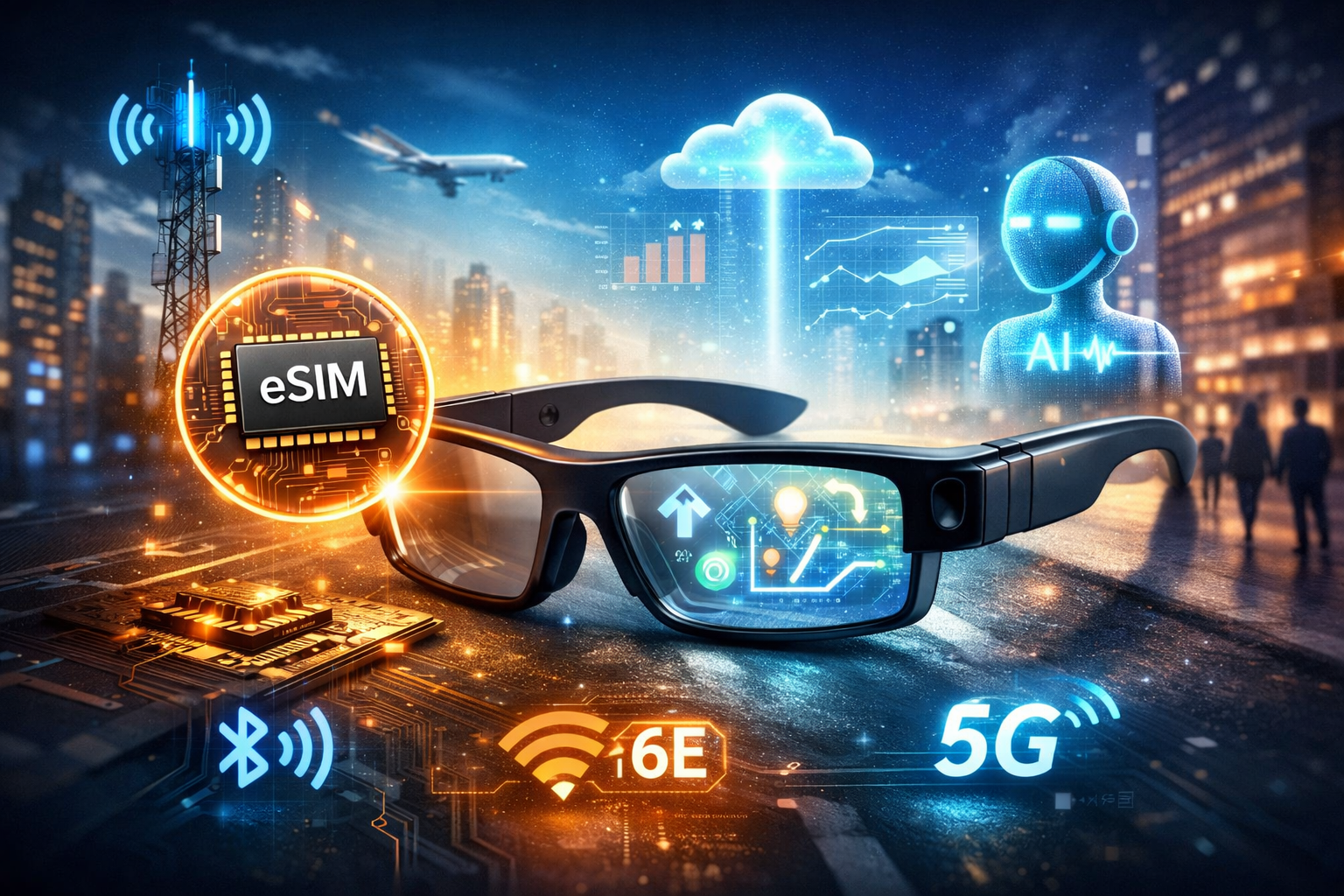
Modern eSIM technology can be smaller than a grain of rice. This tiny innovation changes how AI glasses stay connected everywhere you go. AI glasses with eSIM technology stand among the most important advances in wearable tech that removes physical SIM cards and provides uninterrupted network access.
AI glasses equipped with eSIM technology enhance our digital experience through always-on connectivity. These smart wearables switch automatically between known Wi-Fi networks and cellular connections to keep you connected. The cellular AI glasses support multiple Wi-Fi bands including 2.4GHz and 5GHz frequencies. Advanced models now feature Wi-Fi 6E that delivers lower latency and higher efficiency. Major device manufacturers in India and globally welcome this technology. They follow the path that Apple pioneered with their cellular watch variants since 2017. The Indian eSIM wearable market leads a transformation in connectivity delivery that eliminates physical components and makes the user experience simpler.
This piece will explore how eSIM technology powers AI glasses anywhere. We'll examine the multi-radio architecture, dynamic network switching, and how manufacturers overcome miniaturization challenges to build these sophisticated devices.
eSIM technology forms the backbone of modern cellular AI glasses. It lets them connect to mobile networks without traditional SIM cards. These devices stay connected whatever their location.
The embedded SIM (eSIM) has replaced traditional physical SIM cards in connected devices. Connected smart glasses now come with built-in eSIMs instead of removable cards. Today's eSIM solutions are tiny. Some measure just 1.8 x 1.6 x 0.4 mm - smaller than a rice grain and 37 times tinier than standard Nano SIMs.
This small size brings several benefits to esim enabled wearables:
- No need for SIM card slots saves space
- Better durability with no removable parts
- Tighter security through hardware integration
- Less plastic waste helps the environment
Remote SIM provisioning (RSP) stands out as eSIM technology's key feature. It lets users manage network profiles over the air. Cellular AI glasses can download, install, and switch between carrier profiles without swapping physical SIMs.
Users can request activation from their mobile carrier and install the eSIM profile through a QR code scan. The whole process happens digitally. It also lets users store multiple cellular profiles. To name just one example, iPhone models can hold eight or more eSIMs and use two numbers at once.
This feature helps travelers who can switch to local carriers easily. They avoid hunting for physical SIMs or paying high roaming fees.
eSIM wearable India market has grown by a lot over the last several years. Major carriers like Airtel, Jio, and Vodafone-Idea now support eSIM technology. Smart glasses and other wearables benefit from this support.
eSIM smart glasses in India now have optimized activation methods. Reliance Jio's eSIM Simple Setup sends new eSIMs straight to compatible devices. Jio and Airtel also offer QR code activation to speed up the process.
India's growing adoption of this technology points to wider use in wearables. The success with smartwatches paves the way for more advanced AI-enabled eyewear.
Modern connected smart glasses use a sophisticated multi-radio architecture to maintain smooth connectivity in different environments. These devices coordinate multiple wireless systems. Each system plays a specific role in the connectivity ecosystem.
BLE acts as the primary "digital leash" between esim enabled wearables and smartphones.
This constant, low-power connection helps glasses to:
- Stay connected while using minimal battery power
- Start up instantly from sleep mode
- Get notifications and control signals from the paired phone
BLE creates a personal area network that manages everything from audio streaming to relay touch commands and sensor data. It works as the backbone of daily connectivity and helps cellular AI glasses work all day without draining the battery quickly.
Connected smart glasses can utilize Wi-Fi for data-heavy operations when they're not moving in homes, offices, or public spaces. New models come with Wi-Fi 6/6E that offers several technical benefits:
Wi-Fi 6E extends communication into the 6GHz band, letting devices work beyond the usual 2.4GHz and 5GHz frequencies. This technology enables faster data transfers with less interference—a crucial factor for demanding augmented reality applications.
Wi-Fi 6E provides lower latency and better efficiency. These features make it perfect for streaming HD content, downloading large AR assets, and running complex cloud-based AI computations. This advanced Wi-Fi standard gives users freedom for experiences that need lots of data.
Esim in AI glasses with 5G connectivity represents the ultimate wireless freedom. Users can connect their glasses directly to cellular networks without needing a smartphone.
5G's ultra-low latency becomes especially valuable with AR applications. Complex computations move to cloud servers and return almost instantly. 5G connectivity helps esim smart glasses in India and other regions maintain internet access for essential functions like navigation overlays, live translations, and information retrieval.
Smart glasses switch between BLE, Wi-Fi, and cellular connections to optimize both performance and power use based on what's available and needed.
The power of esim in ai glasses goes beyond multiple radios—these components work together to optimize connectivity and preserve battery life.
Cellular AI glasses use sophisticated connectivity stacks that monitor signal strength, bandwidth needs, and power usage. This smart system creates smooth transitions between networks:
- Your glasses switch automatically to cellular without disrupting playback when you leave Wi-Fi range while streaming content
- They wait for Wi-Fi access to save cellular data when uploading large files
- Simple notifications run on low-power Bluetooth, and power-hungry radios activate only when needed
Specialized hardware drives power efficiency in connected smart glasses. Bluetooth Low Energy remains the top choice for wearables because it works well with low duty cycles. New alternatives like electro-quasistatic signals consume 50x less energy compared to traditional wireless methods.
These devices use aggressive sleep modes where radios shut down within milliseconds after data transfers complete. The most effective approach combines BLE for regular syncing with LTE when users move away from paired smartphones.
Esim enabled wearables use dedicated connectivity co-processors to make quick switching decisions. Modern chips can transmit information through lower-frequency signals, sending data 10x faster than Bluetooth while using 100x less energy.
These specialized processors work like an artificial peripheral nervous system. This allows esim smart glasses in India and worldwide to manage complex AI tasks efficiently.
Building ultra-compact esim in ai glasses brings major physical design challenges beyond the eSIM component itself. Engineers tackle complex issues with connectivity, materials, and heat management in tiny spaces.
Connected smart glasses need creative antenna solutions due to physical limits. Research points to optimal antenna placement at frame edges right below the hinges.
This setup allows engineers to:
- Build slim 1×4 antenna arrays that achieve 2×2 MIMO connectivity
- Keep RF exposure away from sensitive eye areas
- Match the plane of network transmission
The metallic frame elements can serve two purposes - providing structural support and working as antenna components. These elements function as antenna grounds or monopole elements, with lengths calculated based on target frequencies. A quarter-wavelength monopole antenna for 2.4 GHz communications needs about 30mm length.
Cellular AI glasses need special materials that let radio signals pass through while staying strong. Aramid-epoxy composites work better than fiberglass at letting radio waves through, with lower dielectric values (ε = 2.87 and tan δ = 0.037). These materials let through up to 83% of signals at certain frequencies.
Most esim enabled wearables store batteries in temple arms, which creates heat management challenges. Smart glasses use 1-3W of power under different workloads, and this heat must be managed carefully to protect the skin.
Research shows that putting heat sources on both sides can lower temperatures near the ear by 51.4%. Material choice matters too. The temples that touch skin should use low conductivity materials like cellulose acetate, while rims work best with high conductivity metals like aluminum for better heat control.
Esim smart glasses in India and other markets don't have replaceable batteries. Manufacturers choose smaller size over easy repairs.
eSIM technology is the life-blood of modern AI glasses that has changed how wearable devices connect to networks worldwide. These tiny embedded chips—smaller than grains of rice—do away with physical SIM cards and provide uninterrupted connectivity in any environment.
Smart glasses use a multi-radio setup that combines Bluetooth, Wi-Fi 6E, and cellular connectivity to adapt to different scenarios. The system switches networks on its own to balance performance against power use. This helps extend battery life while keeping the best possible connection.
Design teams face big challenges when building these complex devices. They need to place antennas carefully, use radio-transparent materials, and manage heat effectively. These steps help create comfortable wearables that work well, even with tight space limits.
This blend of eSIM technology with AI glasses marks the start of bigger changes ahead. We'll see better versions as manufacturers solve current problems. Better batteries will run longer, and smaller components might lead to lighter, less noticeable designs.
Without doubt, as more people worldwide adopt eSIMs, including in markets like India, we'll see smarter applications that combine connectivity with artificial intelligence. These connected glasses will then become valuable tools for boosted productivity instead of just tech gadgets.
The technical basics we covered here show why eSIM-enabled AI glasses work anywhere. This marks a big step toward creating truly wireless, always-connected wearable experiences that blend naturally with our daily routines.
eSIM Smart Glasses
https://www.globalyo.com/blog/the-future-of-wearable-technology-esim-compatible-smart-glasses-revolutionize-connectivity/
Wearable Connectivity Study
https://pmc.ncbi.nlm.nih.gov/articles/PMC7085683/
Wearable Power Management
https://arshon.com/blog/power-management-in-wearable-electronics-strategies-for-longer-life-and-smarter-designs/
eSIM Profile Switching
https://www.zimconnections.com/how-to-switch-between-esim-profiles-without-losing-connectivity/
India eSIM Support
https://www.samsung.com/in/support/mobile-devices/galaxy-esim-and-supported-network-carriers/
eSIM Wearables Growth
https://kigen.com/resources/blog/the-growth-of-esim-compatible-smartwatches-in-india/
XR Antenna Design
https://www.nokia.com/blog/how-xr-glasses-are-making-us-rethink-antenna-design/
Energy-Efficient AI Chips
https://www.purdue.edu/newsroom/2024/Q3/inspired-by-the-human-body-engineer-designs-chips-that-could-make-wearable-ai-more-energy-efficient
Smart Glasses Battery
https://www.theverge.com/news/608248/smart-glasses-battery-wearables
Wearable Antenna Patent
https://patents.google.com/patent/US20230041962A1/en

By signing up, you are agreeing to Terms of service and Privacy policy.
You can withdraw consent at any time.
.svg)
.svg)
.svg)

.png)
