

.svg)
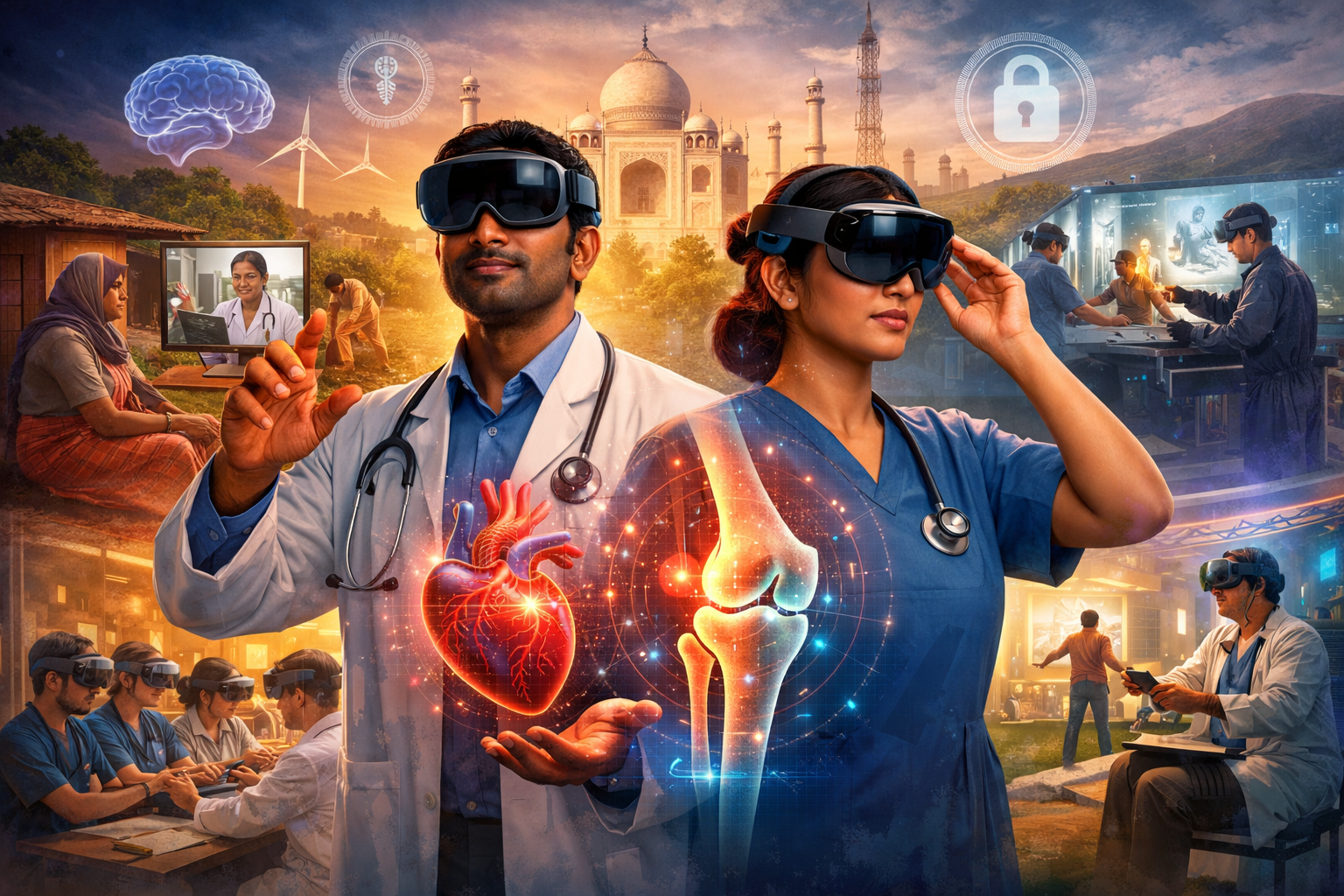
India faces a severe healthcare crisis with just one doctor for every 1,457 people. This ratio is nowhere near the global average of one doctor per 600 people. Rural India's situation looks even worse, showing an 82 percent shortage of surgeons. State-of-the-art immersive technologies now provide promising answers to these urgent healthcare needs.
The Indian AR and VR market should reach $14 billion by 2027. This growth points to a radical alteration in healthcare delivery and training methods. Medical professionals must understand how immersive technology can enhance patient care and medical education. Research backs VR use in rehabilitation. Extended reality medicine gives patients new ways to practice movements and daily activities in controlled, safe spaces. These solutions could make telehealth mainstream across India and revolutionize remote diagnosis and consultation.
This piece looks at immersive technology's role in today's healthcare market. We'll get into its uses for India's unique healthcare challenges and what it takes to implement these systems. Knowledge about these trailblazing solutions helps us prepare for a future where technology bridges crucial gaps in our healthcare system.
India's healthcare system faces most important infrastructure and access challenges that go beyond doctor shortages. Patients in rural areas don't have adequate medical facilities and must travel long distances to get simple care. Medical education also faces tough hurdles because of limited training resources and fewer opportunities to practice.
Immersive technology in healthcare provides practical solutions to these systemic problems. Medical students can use virtual reality simulations to practice complex procedures many times without risking patient safety. This technology helps address the training deficit effectively. Doctors can keep their skills sharp through regular VR practice sessions. These sessions are especially valuable when surgeons in remote areas rarely perform certain procedures.
Extended reality medicine helps patients understand their conditions and treatment processes better, which leads to improved compliance and outcomes. Communities in remote areas can now access specialized care through detailed virtual consultations that work better than traditional telemedicine.
Immersive technology's value to India comes from its adaptable and economical solutions scalability and cost-effectiveness after the original investment. One VR setup can train hundreds of medical professionals, making it a viable option in resource-limited settings. The technology's falling prices mean smaller hospitals and clinics across India can start immersive medical training programs. This gradual change helps bridge the urban-rural healthcare gap.
Immersive technologies now serve practical purposes in Indian healthcare systems. Pediatric cardiologists at Amrita Hospital in Kochi use extended reality (XR) to visualize complex heart diseases. Doctors can now see medical imaging in three dimensions with better clarity. This advancement helps surgical teams plan procedures with precision and leads to shorter surgeries and lower treatment costs.
Surgeons at Peerless Hospital have adopted Microsoft HoloLens for knee replacement surgeries. The AI-driven headset creates a holographic view of the patient's entire limb and offers substantially better visualization than traditional methods. Pixee Knee Plus, an AR-based surgical navigation system, places implants with millimeter-level accuracy. This precision reduces complications and speeds up recovery.
VR has produced remarkable results in medical education. Students using VR scored much higher in retention tests (14.1 vs 10.3) compared to those using traditional learning methods, according to a study of final-year MBBS students. The Apollo Simulation Center in Chennai provides safe training environments with sophisticated task trainers. KD Hospital in Gujarat launched India's first VR nursing training lab.
Mental health facilities now offer VR therapy for anxiety disorders, phobias, and PTSD. Patients can face their triggers safely under controlled conditions. VR-based mirror therapy has also helped post-stroke patients and amputees with phantom limb pain. The technology creates visual illusions that stimulate damaged nerve connections.
The adoption of immersive technology in healthcare is growing in India, but major hurdles still exist. Systems cost between INR 8.4 to 25.3 million. This high cost makes it hard to implement these technologies widely, particularly in places with limited resources.
Healthcare facilities face big technical challenges. They struggle to connect immersive platforms with electronic health records because of compatibility problems and lack of standard protocols. These technical barriers slow down the adoption of groundbreaking solutions.
Data security is a crucial issue since healthcare immersive technology handles sensitive patient information. Patient data becomes more vulnerable with multiple access points. This makes strong security protocols essential.
Medical professionals often show resistance to new technologies due to their heavy workloads. They need dedicated time to learn these systems properly, which creates practical challenges in implementation.
The development of extended reality medicine must follow ethical guidelines. Future solutions in immersive healthcare should follow bioethical principles. These include autonomy, justice, and non-maleficence. This ensures people of all backgrounds can access these technologies.
Only 25% of Indian healthcare systems work with foreign healthcare organizations. This limited collaboration holds back research progress and real-life applications of immersive medical training.
Healthcare immersive technology marks a crucial turning point in India's medical landscape. We got into how extended reality applications tackle critical shortages in our healthcare system. The doctor-to-patient ratio of 1:1,457 falls substantially below global standards.
India's AR and VR market will reach $14 billion by 2027, which definitely shows these technologies' game-changing potential. VR-based medical training programs have showed clear improvements. Students achieve higher retention scores compared to traditional methods. Three-dimensional visualization at Amrita Hospital and Peerless Hospital improves precision and reduces patient costs.
Notwithstanding that, several roadblocks stand in the way of widespread adoption. Rural facilities face substantial cost barriers where healthcare gaps hit hardest. Healthcare facilities need to think about data security as they implement these systems. The integration between immersive platforms and existing electronic health records needs standardized protocols.
These expandable and affordable healthcare solutions work well in our resource-constrained settings, despite the challenges. A single VR setup trains hundreds of medical professionals. Smaller hospitals and clinics nationwide can narrow the urban-rural healthcare divide as technology becomes more affordable.
Indian healthcare will without doubt benefit from smart implementation of these technologies. Medical professionals must stay informed about emerging applications. We need to advocate for solutions that prioritize ethical considerations and equitable access. Immersive technology offers a practical way to address fundamental healthcare challenges across India. It bridges critical gaps in medical education, improves surgical outcomes, and brings quality care to previously underserved communities.
Extended Reality Diagnosis
https://www.sify.com/science-tech/how-improved-illness-detection-might-be-aided-by-extended-reality/
HoloLens Knee Surgery
https://indiaai.gov.in/news/doctors-at-peerless-hospital-show-how-hololens-boosts-knee-replacement-surgeries
AR Knee Insights
https://drrishisanghavi.com/dr-rishi-shares-insights-on-augmented-reality-knee-surgery/
Medical XR Education Study
https://link.springer.com/article/10.1186/s12909-025-08346-6
VR Nurse Training
https://www.mobihealthnews.com/news/asia/indias-first-vr-nurse-training-lab-opens
Immersive Healthcare Research
https://www.nature.com/articles/s41598-023-40546-2
Clinical VR Review
https://pmc.ncbi.nlm.nih.gov/articles/PMC11368352/
Healthcare Immersive Market
https://www.researchnester.com/reports/immersive-technology-in-healthcare-market/7104
XR Healthcare Whitepaper
https://www.infosys.com/services/microsoft-cloud-business/insights/documents/xr-transforming-healthcare.pdf

By signing up, you are agreeing to Terms of service and Privacy policy.
You can withdraw consent at any time.
.svg)
.svg)
.svg)

.png)
