

.svg)
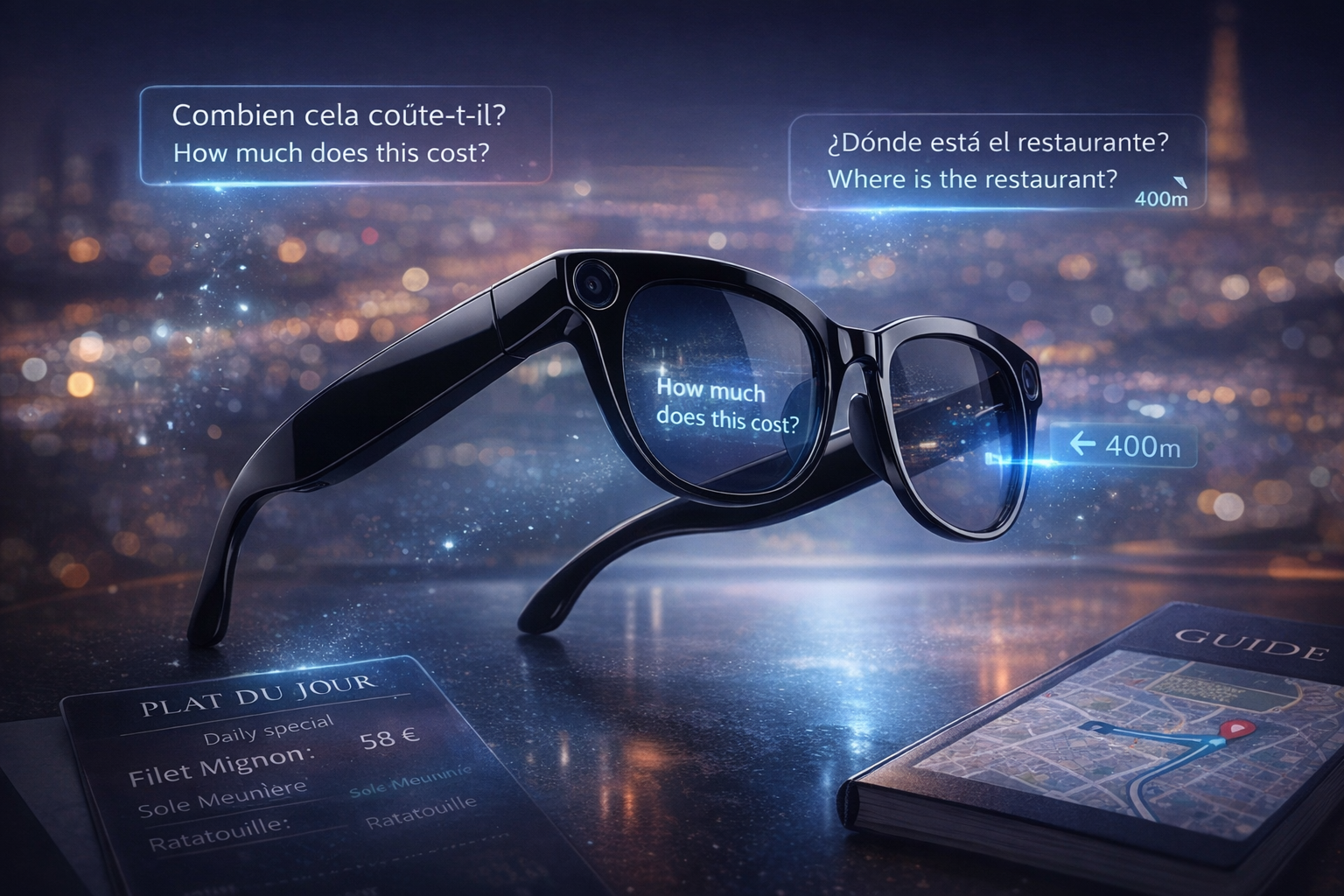
Real-time translation glasses are reshaping how we communicate across languages. They offer instant translations through wearable technology that feels effortless. These AI-powered devices can translate spoken conversations in languages such as French, German and Spanish in real time. Your hands stay free the whole time. Google's Verily Life Sciences showed confidence in smart glasses technology by launching Project Baseline and recruited 10,000 participants to integrate wearable device data. Indian buyers thinking over this technology in 2026 face a question that isn't just about features but actual value.
In this piece, we'll get into what real time translation smart glasses offer and their practical benefits for travel and business. We'll also cover limitations you should know and whether they're worth the investment.
Translation smart glasses operate through a three-stage process that happens faster than you might expect. The system captures spoken language through microphones, processes and translates it using AI software, then delivers the result through speakers or a visual display. Audio gets transcribed into text first at the time someone speaks in front of you. The text then passes through a translation engine that converts it into your target language. A text-to-speech model generates audio that plays through the glasses' speakers, and all this happens in near-real time.
The speed has improved a lot. Engineers managed to reduce latency from over 5 seconds down to 2.7 seconds, a 46% improvement that makes conversations feel more natural. The system can now understand, translate, and generate speech in a streaming fashion within the interval of a few words without waiting for complete sentences.
The hardware packed into these frames handles serious computational work. Microphone arrays use beamforming technology, which focuses on capturing sound from a specific direction while filtering out ambient noise and background chatter. This directional audio capture distinguishes between the wearer's voice and their conversation partner, which directly affects translation accuracy.
The processing unit houses a compact System-on-a-Chip (SoC) containing a CPU, GPU, and sometimes a dedicated Neural Processing Unit. This processor manages real-time speech recognition, language processing, and translation calculations. Battery life and translation speed depend on its efficiency.
Display technology varies between models. Waveguide displays use tiny projectors that beam light onto transparent lenses etched with microscopic gratings and create text that appears to float in your field of vision. Some glasses skip displays and use speakers to deliver translated audio directly into your ear.
Cameras enable visual translation. Point at signs, menus, or documents, and the dual-camera system (RGB camera and B&W camera for spatial sensing) recognizes text even in challenging lighting conditions.
Voice translation relies on Automatic Speech Recognition (ASR) engines powered by deep learning models. These neural networks convert audio into text while accounting for different accents and speaking speeds, trained on millions of hours of speech data.
Translation processing happens either online or offline. Online translation connects to cloud-based AI models trained on vast linguistic datasets and delivers more accurate results but requires stable internet. Offline translation uses downloaded language packs stored on the device and functions without data connections though with lower accuracy.
Output methods split between audio feedback and Head-Up Displays (HUD). Audio feedback plays translations like earbuds and creates conversational flow. HUD systems project translated text as subtitles in your line of sight and offer a silent method ideal for business meetings or noisy environments.
Travel scenarios demonstrate where live translation glasses deliver immediate value. Restaurant experiences transform when you read menus through smart glasses that overlay translations. You understand ingredients and preparation methods without breaking conversation flow with dining companions. Street signs, transit information and directional signage turn comprehensible in an instant. You move through unfamiliar cities with confidence and understand warnings while following directions without constant phone reference.
Shopping benefits extend beyond simple transactions. Translation lets you compare products, understand specifications and negotiate prices with actual comprehension rather than relying on gestures. Whether ordering at restaurants, asking for directions or handling accommodations, live translation smart glasses convert stressful situations into manageable interactions.
International business involves constant cross-language communication during meetings, negotiations and factory visits. AI translation smart glasses 2026 models let professionals work directly rather than through interpreters or deal with translation delays. Technical discussions benefit from precise terminology translation that general interpreters might not provide.
Document review during negotiations becomes quicker. You can review contracts or specifications through smart glasses while maintaining natural body language during discussions. Relationship building in international business requires informal communication. Translation technology makes conversations during meals or social events possible without obvious device use that creates barriers to natural rapport.
Language barriers affect personal relationships too. Families and couples from different cultural backgrounds use live language translation glasses for daily conversations about routines or emotions without sacrificing their native language. In multicultural communities, these devices help maintain eye contact while following conversations, displayed as captions in your visual field.
Academic environments now involve international collaboration. Translation supports students working with foreign language materials and participating in multilingual discussions. The technology displays both original text and translations at once. This allows gradual recognition of common words while maintaining comprehension. This immersive approach works well for visual learners who benefit from seeing written forms of spoken words.
Translation performance remains inconsistent. Current systems support only Spanish, Italian, French, and German, with AI identifying but not translating other languages. The technology paraphrases rather than delivering word-for-word translations and offers broad summaries instead of precise breakdowns. Performance proves buggy and temperamental. It functions more as a novelty than a reliable travel tool.
Power consumption presents the most important constraint. Video capture, text recognition, and neural translation drain batteries faster. Most models deliver only a few hours of continuous use when running intensive features. The computational intensity of running cameras, processors and displays at once limits practical usage time.
Smart glasses create serious privacy risks. Built-in cameras and microphones enable covert recording and facial recognition without visible indicators. Biometric data collection triggers legal complications under privacy laws, with penalties reaching large amounts per violation. Voice recordings train AI models by default. Automatic recording cannot be disabled. Recording others without consent violates laws in multiple jurisdictions.
Pricing in India has multiple cost layers. Import duties add high percentages to base prices, followed by 18% GST applied to the total landed cost. Distribution channels add profit margins at each level and inflate final retail prices compared to international markets.
Ray-Ban Meta smart glasses retail at ₹29,900 in India and offer translation in English, French, Italian and Spanish. The LLAMA 4 AI model integration enables voice-activated assistance through "Hey Meta" commands without unlocking your phone. Battery capacity increased 42% and delivers up to 5 hours of music playback and 5.4 hours of voice calls. The 12-megapixel ultra-wide camera records 3k videos up to 3 minutes that you can share through voice commands. Translation functions work offline once language packs download, with transcripts available on connected smartphones.
Google plans to launch two smart glasses models in 2026. The audio-only version has speakers and microphones for Gemini AI interaction. The display model has an in-lens screen that shows navigation directions and live translation captions. Strategic collaborations with Warby Parker, Samsung and Gentle Monster will produce the Android XR-based devices. Processing occurs on connected smartphones rather than in the glasses themselves.
Rokid AI Glasses start at ₹25,229.75 and undercut Ray-Ban Meta's ₹31,980.19 display version. The 49g frame houses a 12MP camera with Low-Light HDR and a 0.15cc Micro-LED engine that delivers 1500-nit brightness. GPT-5 model integration supports voice activation through "Hi Rokid" commands. Even Realities G2 glasses cost ₹50,543.89 but deliver superior display quality and translation performance.
Real-time translation glasses offer genuine benefits for international travel and business communication, but the limitations remain most important to understand. Battery life restricts extended use and accuracy varies. Indian pricing adds substantial costs through import duties and taxes.
Think over your actual usage patterns first before you invest in technology that might underwhelm. Frequent international travelers will find value here, and business professionals working in multiple languages will too. Casual users should wait. Better language support and more competitive pricing need to arrive before committing.
RayNeo Translator Glasses
https://www.rayneo.com/blogs/news/smart-glasses-as-your-personal-translator-breaking-language-barriers-in-real-life?srsltid=AfmBOor3L3AqQG9BKODDVtYEbRhjv153zEquHQW4QrcOhKLFB38LYwcE
Even Realities Translation
https://www.evenrealities.com/blog/ai-translation-glasses?srsltid=AfmBOoouegNofZbulwKdCkJVztRCjjx1ukGB1YWENjAGvZ3_jUVsjmFA
Privacy Concerns Update
https://dig.watch/updates/ai-smart-glasses-raise-new-privacy-concerns
Rokid Translation Explainer
https://global.rokid.com/blogs/articles/how-ai-translation-glasses-breakthrough-language-barriers-revolutionizing-global-communication?srsltid=AfmBOoo6zWCv3s94zpyu1NGslt6PU8hLuAceSwliAJNhxAfhewWDeEnF
Meta Travel Tips
https://www.meta.com/ai-glasses/travel-tips/?srsltid=AfmBOooUTeTBA898C1acdjP0RmehbgsPOnISQs4ewEKhJjiwcvs_aqPe
Wired Translation Test
https://www.wired.com/story/meta-ray-ban-ai-translation-skills-do-not-work-well/
Smart Glasses Privacy Risks
https://www.purduegloballawschool.edu/blog/news/smart-glasses-privacy-risks
India Launch Coverage
https://www.cnbctv18.com/technology/ray-ban-meta-smart-glasses-india-launch-price-availability-more-ws-l-19604091.htm
Ray-Ban Meta Product
https://www.ray-ban.com/usa/ray-ban-meta-ai-glasses
CNBC 2026 Glasses
https://www.cnbc.com/2025/12/08/google-ai-glasses-launch-2026.html
Reuters Google Warby
https://www.reuters.com/business/warby-parker-google-launch-ai-powered-smart-glasses-2026-2025-12-08/
MacRumors Google Glasses
https://www.macrumors.com/2025/12/08/google-ai-smart-glasses-2026/
CES 2026 Best Glasses
https://mashable.com/article/best-smart-glasses-ces-2026
Rokid Glasses Page
https://global.rokid.com/pages/rokid-glasses?srsltid=AfmBOopmpgHZ8lPVijyMR1jHu2SkQrwgjCZ_0csiCG8sn04uUifmuOUw

By signing up, you are agreeing to Terms of service and Privacy policy.
You can withdraw consent at any time.
.svg)
.svg)
.svg)

.png)
