

.svg)
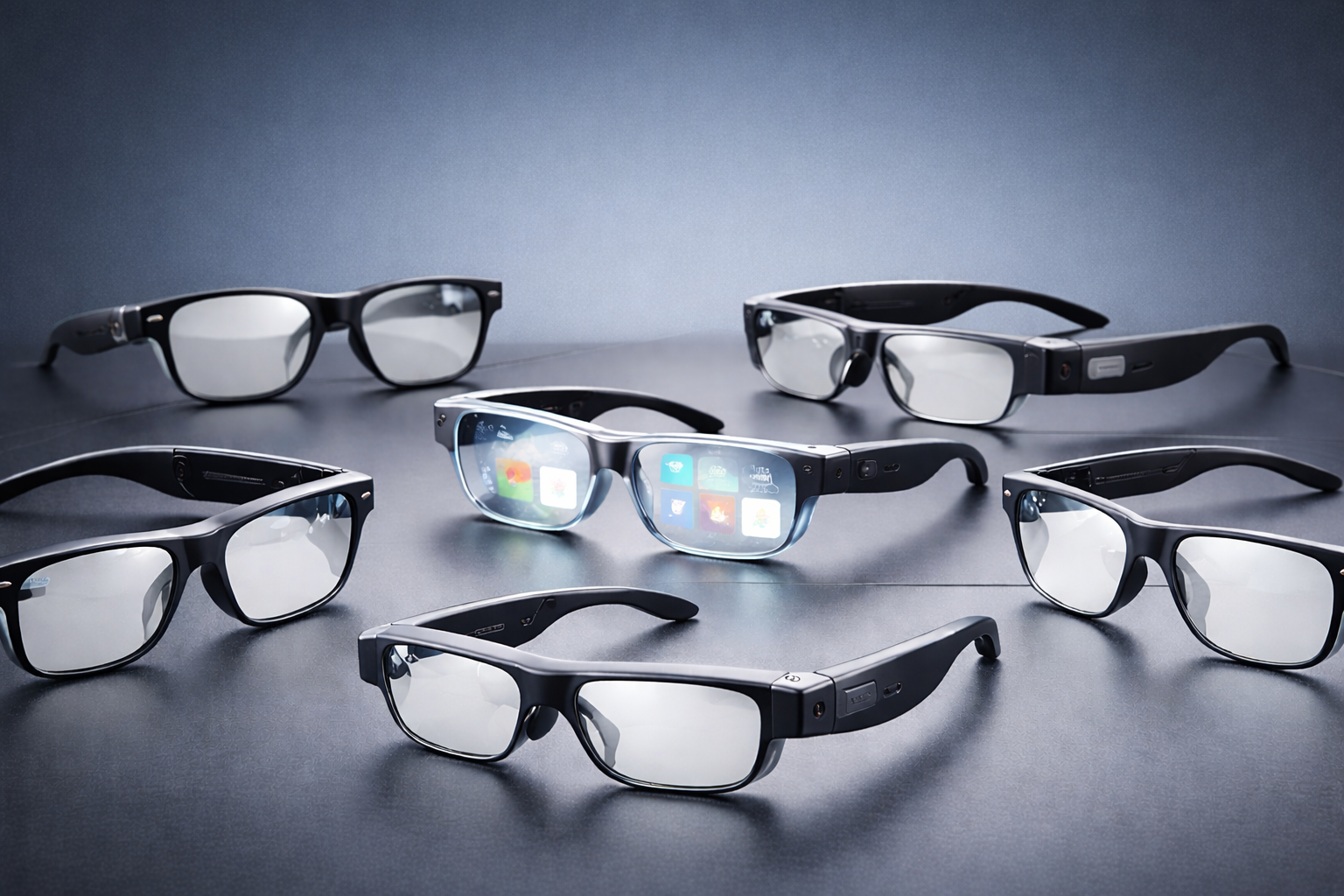
Smart glasses are no longer experimental gadgets or niche tech demos. In 2026, they are emerging as a serious consumer category—positioned at the intersection of AI, optics, cameras, and wearables.
Unlike earlier attempts, today’s AI smart glasses are designed to blend into daily life. They don’t try to replace smartphones. Instead, they reduce friction—capturing moments, delivering information, and providing assistance without demanding attention.
From travel and work to gaming and education, smart glasses are quietly reshaping how people interact with the world.
At their core, smart glasses are wearable computers built into eyewear. But in 2026, that definition has matured.
Modern smart glasses typically combine:
- Cameras for first-person perspective
- Microphones for voice interaction
- Speakers or bone-conduction audio
- Sensors for movement and context
- AI models for interpretation and assistance
Some smart glasses include displays. Many don’t. And that distinction defines how they’re used.
Smart glasses aren’t defined by one use case. Their value comes from how naturally they fit into everyday life.
Smart glasses support:
- Real-time translation
- Navigation assistance
- Hands-free capture
They reduce friction while moving through unfamiliar environments.
In professional settings, smart glasses offer:
- Subtle notifications
- Voice-driven AI assistance
- Hands-free information access
They work best as a companion device and not a screen replacement.
For creators and gamers, smart glasses enable:
- First-person capture
- Companion experiences
- Social and streaming integration
They bridge physical and digital entertainment without full immersion.
In education, smart glasses open up:
- Context-aware learning
- Visual explanations
- Accessibility-driven experiences
They support learning in real-world environments, not just classrooms.
Displays are the most challenging component of smart glasses.
Current technologies include:
- Waveguides for transparency and comfort
- Micro-OLED / Micro-LED for sharper visuals
The real challenge isn’t resolution; it’s balancing brightness, field of view, heat, and battery life inside something that still looks like normal eyewear. This is why many brands ship limited display features first.
In 2026, cameras are arguably the most important part of smart glasses.
They enable:
- First-person AI understanding
- Contextual assistance
- Social and creator use cases
What matters most isn’t megapixels - it’s stabilization, low-light performance, and AI-assisted capture. Smart glasses with camera quality often determine long-term adoption.
When you buy smart glasses in India, the decision shouldn’t start with specs or hype.
Focus on:
- Your primary use case
- Comfort and all-day wear
- Camera and audio quality
- Battery efficiency
- Ecosystem compatibility
Smart glasses price in India varies widely, but the right choice depends more on fit and function than raw features.
India is uniquely positioned for smart glasses adoption:
- A mobile-first population
- A growing creator economy
- Increasing comfort with wearables
As AI models become smaller and optics improve, smart glasses will transition from niche gadgets to everyday computing tools.
Smart glasses in 2026 are no longer experiments. They’re practical, improving fast, and finding clear roles in daily life.
The best AI smart glasses don’t shout for attention. They disappear—quietly helping you see, understand, and capture the world more naturally.
2026 isn’t the peak.
It’s the starting line.
[Omdia / Business Wire India] – AI Glasses Market Forecast: Shipments to Exceed 10 Million Units in 2026 Driven by Multimodal Interfaces
[Mashable] – The Best Smart Glasses of CES 2026: A Deep Dive into Waveguides and Translation Tech
[PCMag] – The Best Smart Glasses We've Tested for 2026: Buying Guide and Comparisons
[Google / The Keyword] – Android XR and Gemini: How Generative AI is Powering the Next Generation of Smart Eyewear
[NCBI / PubMed Central] – Optical Architectures for Smart Glasses: A Comparative Study on Visual Comfort and Latency
[ResearchGate] – Wearable Computing in Education: Context-Aware Learning Modules via Smart Glasses
[Insta360 Insights] – POV Camera vs. Smart Glasses: Which is Best for Content Creators in 2026?
[Design & Reuse] – Smart Glasses Market Trends 2026: The Rise of AI OEMs and Consumer Adoption
[Utsav Techie / YouTube] – Smart Glasses Pricing and Buying Guide India: What to Expect in 2026
[SmartBuyGlasses India] – Digital Prescription Integration and Optical Trends for Smart Eyewear in 2026

By signing up, you are agreeing to Terms of service and Privacy policy.
You can withdraw consent at any time.
.svg)
.svg)
.svg)

.png)
